

Running to succeed António Guterres, the Emirati diplomat promises a leaner, results-driven organisation and early mediation from Ukraine to Gaza.
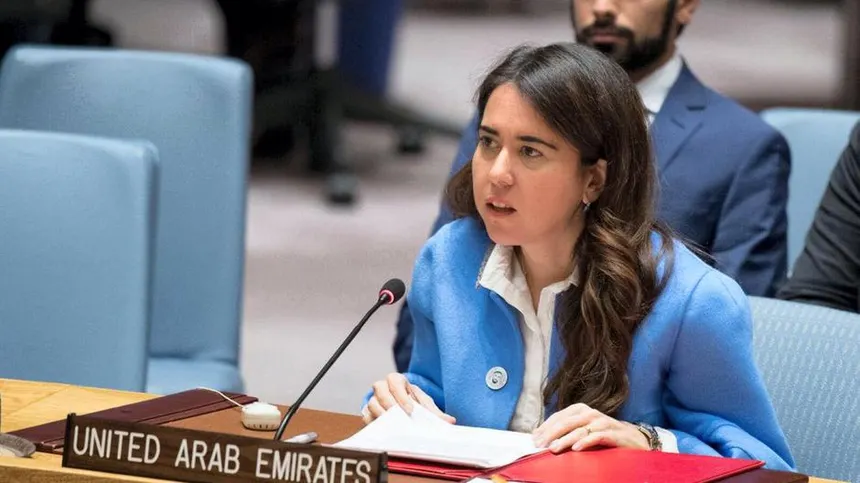
DUBAI, United Arab Emirates — UAE Minister of State Lana Nusseibeh has pledged to act as the United Nations’ chief mediator and take political risks for peace if selected as the next Secretary-General, urging the global body to return to its foundational mission of peace, development, and prosperity.
Speaking in an interview with Euronews as the race to succeed outgoing Secretary-General António Guterres enters its final phase, Nusseibeh described the current geopolitical climate as a “turning point moment” for the organisation. Nusseibeh, who served as the UAE’s ambassador to the UN for over a decade and has taken leave from her ministerial post to campaign, stated that the UN is too often perceived as absent from the 65 active conflicts worldwide.
“I am a relentless diplomat and I intend to offer a candidacy that is about relentless diplomacy,” she said, arguing that the next UN chief must prioritise humanitarian truces and aid access before building lasting political strategies. “It’s not about political theatre, it’s about political risk-taking.”


Addressing financial pressures, including a 23% drop in official development assistance, Nusseibeh proposed narrowing the UN’s operational scope, partnering with external entities where they hold an advantage, and publishing a scorecard of results for member states and donors.

“It’s not around organograms or design structures of the system, but it’s about impact and cost of impact and delivery,” she said. Within her first 100 days in office, she plans to establish a shared vision with member states and civil society, eliminate duplication across thousands of secretariat mandates, and shift the UN’s focus from its headquarters to operations in the field.
If appointed, Nusseibeh would become the first woman to lead the UN since its founding in 1945, the first Secretary-General of Palestinian descent, and the second from the Arabic-speaking world following Egypt’s Boutros Boutros-Ghali. Rejecting identity-based framing, she emphasised that her candidacy rests on more than two decades of diplomatic experience and judgment.
Responding to critics questioning her independence, Nusseibeh pointed to Article 100 of the UN Charter, which mandates the neutrality of the Secretary-General. “The allegiance of a secretary-general is to the UN Charter and to international law and that is what I would pledge in that role,” she said, adding that she welcomes feedback and criticism.
Outlining her operational plans, Nusseibeh said she would balance public advocacy with discreet diplomacy to keep communication channels open during deadlocks. She proposed establishing a mediation board comprising outside experts and UN officials, engaging local community leaders, and making women’s networks the first point of contact for mediation teams. She also committed to creating a dedicated focal point in her office for the protection of aid workers, noting that 300 were killed over the past year.
On specific crises, Nusseibeh stated that any settlement in Ukraine must uphold the UN Charter’s principles of sovereignty and territorial integrity, offering her immediate good offices to move from initial agreements toward a political strategy. Turning to the Middle East—which she noted accounts for 38% of the Security Council’s agenda—she highlighted her personal roots in Jerusalem and her experience negotiating Security Council Resolution 2720 on Gaza aid in December 2023. She pledged to push forward the stalled implementation of Resolution 2803, which endorsed a 20-point plan for Gaza.
“I come to every conflict with a lot of humility that what we have done in all of these situations has not been nearly enough for the people who’ve needed it the most,” she said.
The race remains tightly contested ahead of the December 31 conclusion of Guterres’s term. Repeated informal straw polls in the Security Council have yet to yield a candidate free of opposition from all five permanent members. Former Costa Rican Vice President Rebeca Grynspan currently holds a challenging lead, with Argentina’s International Atomic Energy Agency Director-General Rafael Grossi and Nusseibeh actively campaigning alongside candidates including Guyana’s Carolyn Rodrigues-Birkett, Ecuador’s Maria Fernanda Espinosa and Ivonne A-Baki, Senegal’s Macky Sall, and Uganda’s Olara Otunnu.