



By Senior Political Correspondent
WASHINGTON — In a major diplomatic breakthrough amidst escalating Middle East tensions, Israel and Lebanon have agreed to implement a conditional ceasefire following extensive, US-led negotiations in Washington. The joint communique, issued late Wednesday night, outlines a framework strictly dependent on the complete cessation of hostilities by the Iran-backed militant group Hezbollah and the total withdrawal of its armed elements from the region south of the Litani River.

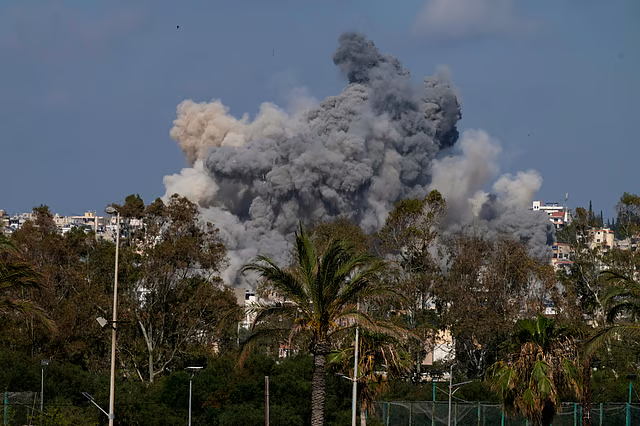
Despite the announcement, the sustainability of the truce remains highly precarious. Moments after the agreement was publicized, fresh hostilities erupted on the ground. A United Nations Interim Force in Lebanon (UNIFIL) peacekeeper was killed and two others were seriously wounded when mortar shells struck their base in southern Lebanon, triggering an immediate international investigation. Concurrently, Lebanon’s state-run National News Agency reported localized Israeli drone strikes along southern highways, resulting in casualties, while the Israeli military confirmed that air raid alarms were activated across northern Israel.
Bipartisan Rebuke in Washington Curbs Executive War Powers
The diplomatic developments coincided with major political drama in Washington. The US House of Representatives approved a resolution restricting President Donald Trump’s authority to conduct unilateral military actions against Iran.



The measure passed with a close 215–208 vote, representing a rare bipartisan break as four Republicans joined Democrats to reassert congressional war powers. Rep. Gregory Meeks (D-New York), ranking member of the House Foreign Affairs Committee, hailed the vote as a vital constitutional check on executive overreach.
President Trump sharply criticized the House resolution on his Truth Social platform, calling the vote “unpatriotic” and claiming it disrupted critical, final-stage negotiations with Tehran. Trump expressed optimism that direct talks with Iran could yield a multi-phase interim agreement as early as “this weekend,” though he explicitly noted his intention to separate the US-Iran diplomatic track from the Israel-Hezbollah conflict.
Ground Realities: Divergent Signals and Continued Casualty Tolls
The view from Tehran remains significantly more cautious than Washington’s optimistic outlook. Iranian Foreign Minister Abbas Araghchi stated that while communication channels with the US remain open, “no tangible progress” has been made. Araghchi emphasized that any comprehensive regional settlement is strictly conditional on the complete withdrawal of Israeli forces from Lebanon and an absolute halt to aggression against Beirut, warning that any strike on the Lebanese capital would trigger a full-scale resumption of war.
Middle East Ceasefire Framework (Proposed Multi-Phase Interim Agreement)
├── Phase 1: Stabilize current ceasefires & prevent new regional fronts
├── Phase 2: Restore maritime security & commercial flows in the Strait of Hormuz
├── Phase 3: Address broader regional security and energy routes
└── Phase 4: Long-term diplomatic resolutions regarding Iran's nuclear program
Meanwhile, the human cost of the conflict continues to climb. Lebanon’s Ministry of Public Health confirmed that recent Israeli air strikes in the Tyre district killed at least eight people. Among the casualties were two paramedics who died when their ambulance was directly targeted in the town of Shahour—an incident the ministry condemned as a severe violation of international humanitarian law.
Gulf Security Threatened After Airport Strike
The fragile regional environment was further strained following a lethal drone attack on Kuwait International Airport’s Terminal 1. Verified security footage captured an Iranian-made Shahed-136 kamikaze drone impacting the passenger terminal, leaving an Indian national dead and dozens wounded.
- Kuwait’s Stance: Prime Minister Sheikh Ahmad Abdullah Al-Ahmad Al-Sabah visited the wounded at Jaber Al-Ahmad Hospital, directing state authorities to mobilize all medical resources for the victims and expressing condolences to the family of the deceased.
- India’s Response: India’s Ambassador to Kuwait, Paramita Tripathi, met with Kuwaiti criminal evidence officials to expedite the repatriation of the deceased citizen’s remains and visited injured Indian nationals undergoing treatment.
- Iran’s Denial: The Islamic Revolutionary Guard Corps (IRGC) denied targeting civilian infrastructure, claiming the damage was caused by a malfunctioning US-made Patriot missile defense system—a claim rejected by regional security analysts.
In response to the multi-front crisis, European Union Foreign Policy Chief Kaja Kallas announced a new 100-million-euro support package for the Lebanese Armed Forces to strengthen state institutions, while international powers continue to monitor whether the Washington-brokered ceasefire can stabilize the region.