

Fragile Truce on the Brink of Collapse as Oil Prices Surge and Gulf Nations Intercept Relentless Missile, Drone Attacks
DUBAI — The United States military has launched a massive, fresh wave of precision air strikes against targets inside Iran after an intense weekend of military exchanges pushed a fragile multi-nation interim truce to the edge of total collapse. The military action, executed by US Central Command (CENTCOM), has triggered widespread retaliatory missile and drone attacks by Tehran across multiple Gulf Arab states, sending global energy markets into an immediate tailspin.
The latest escalatory cycle began late Sunday night and continued into the early hours of Monday, July 13, 2026. According to official statements from Pentagon officials, US aircraft, warships, and unmanned aerial vehicles conducted targeted strikes on Iranian missile installations, air defense networks, and Islamic Revolutionary Guard Corps (IRGC) fast-attack paramilitary boats positioned along the strategic waterway.


The military intervention was ordered by US President Donald Trump following a devastating Iranian assault on Saturday against the M/V GFS Galaxy, a Cyprus-flagged commercial container ship lawfully navigating international transit channels. CENTCOM confirmed that the commercial container vessel suffered massive engine room damage and caught fire. While the majority of the crew members were successfully rescued by international maritime forces, a search-and-rescue operation continues for one missing Indian seafarer.
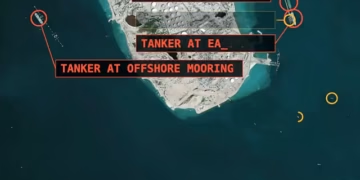
The crucial Strait of Hormuz chokepoint where international shipping routes intersect.. Source: Britannica

The Battle for Maritime Control
Following the attack on the commercial shipping vessel, the IRGC naval command issued an official decree declaring that the Strait of Hormuz was “closed until further notice,” demanding an immediate cessation of all American military operations in the region. Iran alleged that the vessel had ignored maritime security protocols and navigated through an unauthorized lane.

The United States immediately rejected Tehran’s declaration of closure over an international shipping lane. In a public briefing, President Donald Trump stated firmly that the US military had “bombed the hell out of them last night,” reiterating that the vital trade corridor remains operational.
“Iran does not control the strait. Traffic is flowing, and international forces are fully positioned and prepared to keep it that way,” US Central Command stated on its official channels.
Regional Contagion and Interceptions
The US air strikes triggered an immediate, coordinated regional retaliation from Tehran, which targeted several neighboring Gulf states hosting American installations. Air defense warning sirens sounded across the Arabian Peninsula as regional militaries scrambled to intercept incoming barrages.
- Qatar: Authorities confirmed that air defense systems successfully intercepted multiple ballistic missiles fired toward Al Udeid Air Base. Shrapnel from the mid-air interceptions wounded three individuals, including a child, according to the Qatari Interior Ministry. The Hindu
- Oman: The state-run news agency reported drone strikes hitting logistical support hubs near the Port of Duqm, which serves US naval fleets. In an unprecedented diplomatic move since the outbreak of hostilities, Oman officially summoned the Iranian ambassador to log a severe protest against the “irresponsible acts.” The Hindu
- Kuwait: The Ministry of Defense confirmed that three northern land border installations and an offshore drilling platform operated by the Kuwait Oil Company sustained significant structural damage. One oil field worker was reported wounded. The Washington Post
- Jordan: State media confirmed that at least three Iranian ballistic missiles struck areas around the Prince Hassan Air Base, destroying command infrastructure and MQ-9 drone hangars, though no human casualties were reported. The Washington Post
- United Arab Emirates: Loud explosions were heard across coastal regions as defense networks engaged airborne targets. The Hindu
United Nations Secretary-General António Guterres issued an urgent plea from New York, expressing deep concern over the dramatic escalation. Through a spokesperson, the UN chief urged both Washington and Tehran to exercise maximum restraint and imme