

From wading through flooded bypasses to running daily feeding drives, community groups like Model Service Society and Iman Cultural Center provide a vital safety net during extreme weather.
DUBAI —Whenever severe rain forecasts trigger weather alerts across the United Arab Emirates, grassroots volunteer networks activate long before the first storm clouds break. Mobilising through coordinated phone trees and neighborhood watch groups, hundreds of community volunteers deploy across flood-prone corridors in Dubai and Sharjah to tow stalled cars, direct gridlocked traffic, and ensure stranded commuters reach safety.
The operational discipline of these non-governmental groups was put to its most demanding test during the historic downpours of April 2024, when record rainfall inundated arterial highways and brought urban mobility to an abrupt standstill. While emergency response authorities deployed heavy pumps and rescue units, community volunteers worked alongside them on the ground, wading through waist-deep waters to push stalled passenger cars to higher ground and ferry blue-collar workers away from submerged industrial sectors.
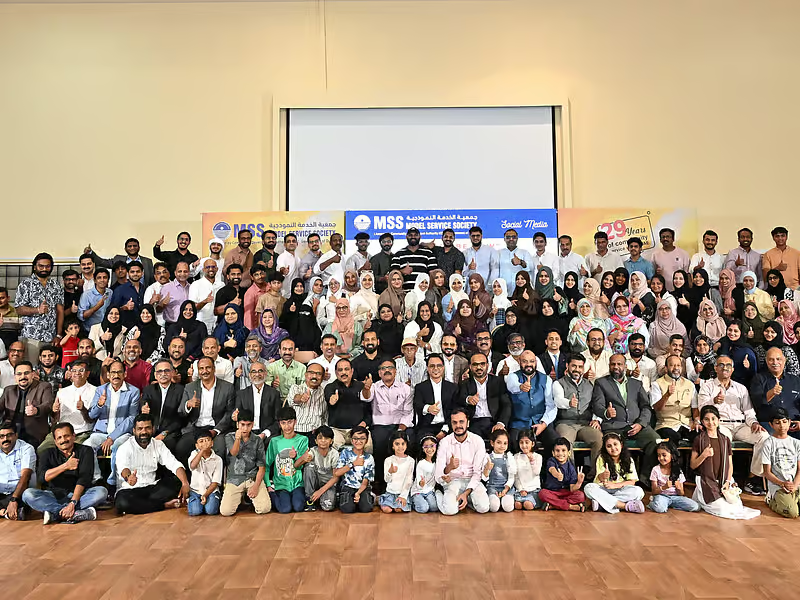
Front and centre among these frontline grassroots networks is the Model Service Society (MSS) Dubai, a community service body that has operated across the Emirates for more than three decades. Rather than treating disaster relief as an ad-hoc gesture, the group maintains year-round standby teams geared for rapid mobilisation.


“MSS was built on the belief that service to society must be consistent, organised, and compassionate,” said Faiyaz Ahmed, Chairman of MSS Dubai. “Our volunteers do not wait for recognition. They step forward because they believe helping others is a responsibility. From emergency response to long-term welfare programmes, our volunteers work selflessly, often behind the scenes.”
That operational discipline earned the organisation official recognition from the Government of Dubai. The Community Development Authority (CDA) recently conferred its Ethraa Gold Award upon MSS following a comprehensive institutional assessment, rating the organisation among the emirate’s highest-performing social service bodies for transparency, fiscal governance, and community reach.
Beyond extreme weather interventions, MSS channels resources into structured empowerment and welfare programmes. The organisation runs employment assistance cells, vocational guidance for youth, and support networks tailored for female residents and low-income blue-collar workers. In Sharjah’s industrial hub of Al Sajjah, MSS manages a continuous, year-round feeding drive that distributes approximately 200 fresh meals every day to vulnerable labourers.

MSS is not alone in maintaining this community frontline. When persistent storm bands trigger localized flooding across municipal boundaries, allied civil society groups step up in tandem.

During recent seasonal inundations across Sharjah and eastern Dubai, the Iman Cultural Center mobilised an emergency contingent of roughly 50 volunteers. Stationed along congested low-lying junctions, the team manually pushed disabled vehicles out of rising floodwaters, regulated traffic bottlenecks at blocked highway exits, and distributed bottled water and fresh fruit to stranded truck drivers and commercial motorists facing hours of delays.
“We could not stand by and watch people struggle,” said Hameed Yasin, head of the Iman Cultural Center. “When people are in distress, the least we can do is stand beside them, offer help, and ensure no one feels alone during an emergency.”
With regional weather patterns increasingly producing concentrated, high-intensity rain events across the Gulf, these non-profit volunteer cadres continue to serve as an indispensable bridge between municipal crisis machinery and vulnerable residents on the road.