

Bilateral non-oil trade reached $15.51 billion in 2025 as the five-decade partnership pivots toward clean energy infrastructure, data governance and strategic investments.
BERLIN — UAE President Sheikh Mohamed bin Zayed Al Nahyan begins an official State Visit to Germany, anchoring a major recalibration of ties between Europe’s largest industrial economy and the Gulf’s premier trade hub. The high-level engagement reflects a transition from a traditional buyer-seller trade pattern into an interdependent, cross-border investment and technological alliance.
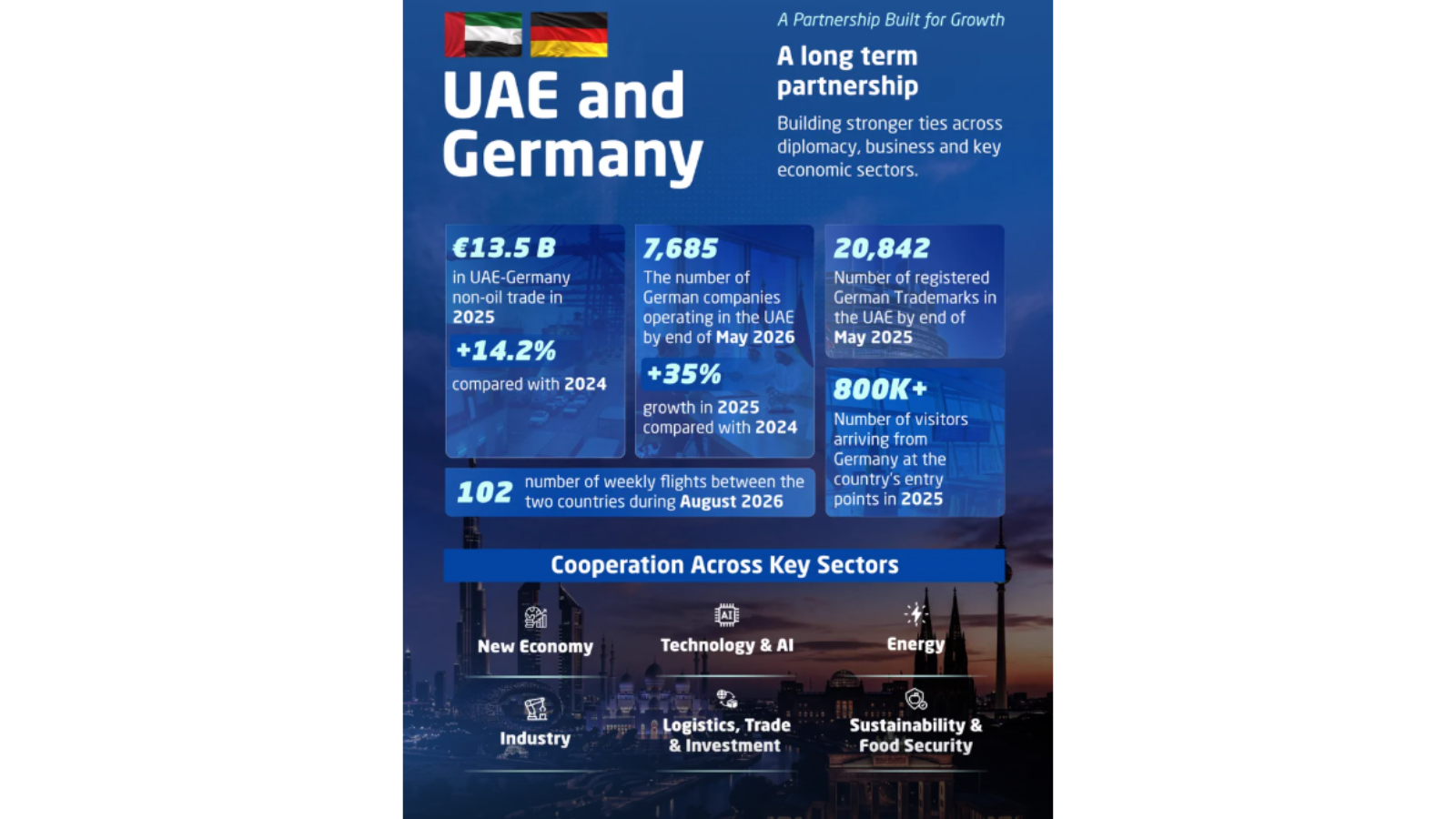
Official bilateral metrics confirm that non-oil merchandise trade between the two nations surged 14.15 percent to $15.51 billion in 2025, up from $13.59 billion in 2024. UAE direct exports to Germany experienced substantial expansion, climbing 57.79 percent to $960.43 million, alongside a 17.01 percent increase in re-exports to $1.20 billion. The economic momentum is underpinned by more than 2,000 German companies operating in the UAE, which established the UAE–German Business Council in July 2025 to steer private-sector capital into industrial manufacturing, logistics and sustainable infrastructure.


Long-term sovereign and institutional capital flows increasingly run two ways. In December 2025, Abu Dhabi-backed investment vehicle XRG concluded a major industrial acquisition of German chemicals manufacturer Covestro, incorporating a €1.17 billion capital injection. The move demonstrates growing Gulf equity participation directly inside Europe’s core manufacturing corridors, complementing Germany’s established engineering presence across the Middle East.

Energy security remains the operational core of the bilateral relationship, which established a dedicated hydrogen task force in 2021 and an Energy Security and Industry Accelerator in 2022. The 476-megawatt Baltic Eagle offshore wind farm in the German Baltic Sea achieved full commercial operation in July 2025, with Abu Dhabi clean energy company Masdar holding a 49 percent equity stake valued at €488 million. In conventional supply lines, German state-owned energy importer SEFE is receiving 700,000 tonnes of liquefied natural gas annually from ADNOC Gas under a three-year procurement contract running through 2027.
German engineering groups retain significant commercial footprints in Gulf infrastructure modernization. In June 2026, Siemens Energy secured the primary contract to supply advanced gas and steam turbine technology for Abu Dhabi’s 2.6-gigawatt Al Taweelah C combined-cycle power project, which is scheduled to commence commercial operations in the third quarter of 2028.
Technological alignment between Berlin and Abu Dhabi has moved into sovereign data governance and artificial intelligence. In May 2026, government delegations engaged in formal negotiations over a sovereign “data embassy” initiative to safeguard critical national data infrastructure. Bilateral energy task forces have simultaneously mobilized 75 public and private entities to engineer sustainable, AI-ready data centers, alongside joint incubator pipelines directly linking German enterprise startups with UAE venture capital funds.
Geopolitical crises have tested and solidified high-level diplomatic coordination. Sustained bilateral diplomacy—including direct engagements involving the German President, Chancellor, and an official working visit to Abu Dhabi by the German Foreign Minister on March 11, 2026—served as a crucial crisis bridge during wider regional military flare-ups. The German Foreign Ministry recognized the UAE as an indispensable operating partner after Emirati logistical corridors facilitated the safe evacuation and transit of over 30,000 stranded German nationals.

Physical connectivity between the two economies reached historic highs as of mid-2026, supported by 94 non-stop passenger and cargo flights per week operated by UAE carriers Emirates (63 frequencies) and Etihad Airways (31 frequencies).
As negotiations progress to elevate the 2004 Strategic Partnership into a Comprehensive Strategic Partnership, Sheikh Mohamed bin Zayed’s visit to Berlin serves as an operational blueprint for European-Gulf diplomacy: balancing industrial capital resilience, advanced technology research, and energy security across volatile global supply chains.