

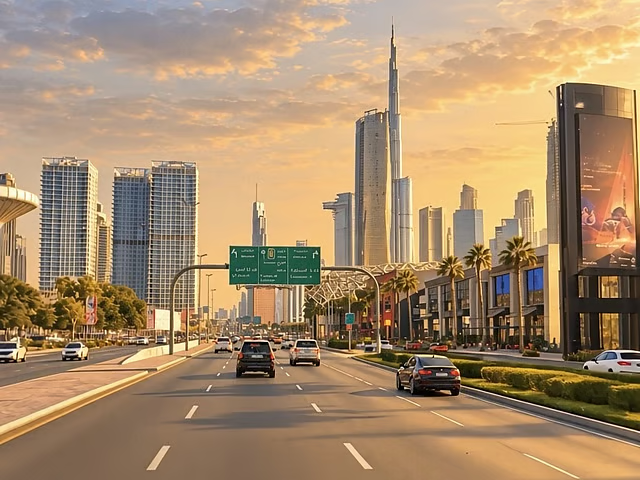
The RTA project adds two bridges and two tunnels between Sheikh Zayed Road and Al Wasl Street to ease central corridor bottlenecks.
DUBAI, Sept. 16, 2026 : A multi-million-dirham infrastructure overhaul along Dubai’s Al Safa Street will slash journey times from 12 minutes to just three minutes while doubling the corridor’s capacity to 12,000 vehicles per hour, the Roads and Transport Authority (RTA) confirmed on Wednesday.
The Al Safa Street Improvement Project covers a critical 1,500-metre segment connecting Sheikh Zayed Road and Al Wasl Street. Designed to eliminate bottlenecks in one of the emirate’s most heavily traversed commercial and residential districts, the upgrade introduces 3,120 metres of newly constructed bridges and tunnels.
Once operational, the project will double vehicle throughput from 6,000 to 12,000 vehicles per hour across both directions, removing repetitive signal stops and separating conflicting traffic streams.




The infrastructure scope includes two overpasses and two subterranean corridors:
- A 1,005-metre, four-lane bridge carrying westbound traffic from Al Wasl Street directly toward Sheikh Zayed Road and Financial Centre Street.
- A 360-metre, two-lane bridge directing traffic outbound from Al Satwa Road onto Sheikh Zayed Road and Financial Centre Street.
- A 1,005-metre tunnel channeling outbound vehicles from Sheikh Zayed Road and Financial Centre Street toward Al Wasl Street.
- A 750-metre, four-lane tunnel—two lanes in each direction—situated at the intersection of Al Wasl Street and Al Safa Street.
Al Safa Street itself is undergoing surface-level restructuring. The carriageway is expanding from three signal-controlled lanes in each direction to four lanes per side. Under the new layout, two dedicated lanes will offer uninterrupted, free-flowing transit, while the adjacent two will manage regulated turns via signalized junctions. Additional dedicated U-turn loops and reconfigured entry-exit slips are being integrated into the corridor.
To prevent gridlock during construction, the RTA has implemented active traffic diversions. Traffic on Al Safa Street has shifted onto paved temporary detour lanes bordering the primary work zone. Concurrently, contractors are modifying the Al Satwa Street and Al Multaqa Street junction to accommodate sustained volumes. Motorists navigating the sector have been advised to observe directional signboards and adhere strictly to revised speed limits.
The initiative functions as a core link within Dubai’s master transportation grid. It aligns directly with concurrent overhauls along Al Wasl Street—which encompasses six intersection redevelopments and five tunnels—and Umm Suqeim Street’s multi-level corridor project. Combined, these arteries establish seamless transit links spanning Sheikh Zayed Road, Al Khail Road, Sheikh Mohammed bin Zayed Road, and Emirates Road.