

Tehran cautions regional bases face attacks if targeted, while Washington cautions that clashes between Saudi Arabia and Yemen’s Houthis risk wider confrontation.
DUBAI / WASHINGTON — September 21, 2026 : The Iranian armed forces warned on Monday that they will retaliate without limits against American bases across the Middle East if Washington resumes strikes against the country, setting an uneasy backdrop as United States President Donald Trump signaled he is open to meeting Iranian President Masoud Pezeshkian at the United Nations this week.
The warning from Tehran’s Khatam al-Anbiya central headquarters followed assertions by Iranian officials that they received intelligence showing the US and unnamed regional allies are preparing for a fresh wave of aerial bombardments. Iranian military commanders stated that any misstep by Washington would turn American installations, personnel, and regional logistics nodes into direct targets of sustained fire.
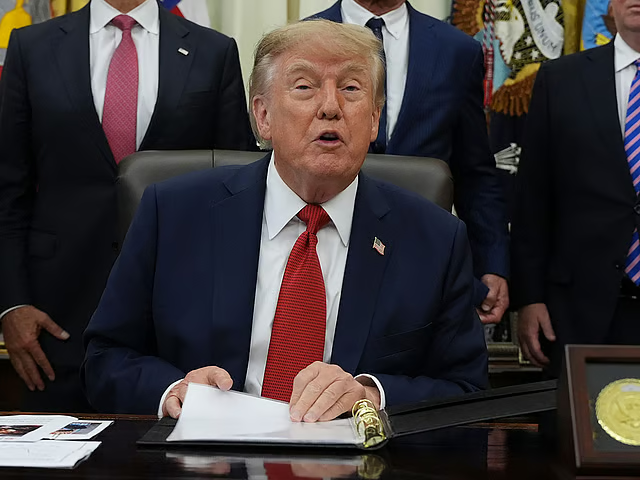
Diplomatic maneuvering has nevertheless accelerated ahead of the 81st United Nations General Assembly high-level debate in New York. Trump confirmed to reporters that he remains in a deciding mode regarding the nearly seven-month confrontation, weighing punitive actions against the possibility of negotiated terms. Asked directly whether he would sit down with Pezeshkian on the sidelines of the international summit, Trump said he would probably be open to discussions.


Iranian officials have approached such prospects cautiously. Tehran has previously ruled out direct negotiations without clear concessions, leaning instead on third-party mediators such as Qatar and Oman. Mohsen Rezaei, secretary of Iran’s Supreme National Security Council, reiterated that any diplomatic resolution requires Washington to lift its naval blockade on Iranian oil ports, unfreeze overseas assets, and fully remove restrictions on crude exports.

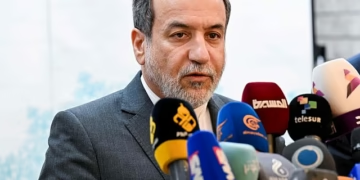
Complicating matters further, the US State Department placed severe geographic restrictions on the Iranian delegation’s travel visas, limiting Pezeshkian and Foreign Minister Abbas Araghchi strictly to UN headquarters and their designated accommodations in Manhattan.
Parallel tensions flared along the southern perimeter of the conflict after Yemen’s Houthi movement fired a ballistic missile toward Riyadh, marking a serious escalation between the rebel forces and Saudi Arabia. Saudi air defense batteries intercepted the incoming projectile, but falling debris caused civilian casualties, according to authorities in the kingdom.
The US State Department subsequently issued an emergency security notice cautioning American citizens throughout the Gulf that military friction could intensify rapidly. The advisory highlighted risks of sudden airspace closures, cancelled commercial flights, and threats against diplomatic facilities throughout the region.

Trump sought to compartmentalize the Yemeni fighting, maintaining that Washington remains in indirect communication with the Houthi leadership and that the group agreed not to target US vessels navigating key transit lanes. Houthi political bureau member Mohammed Al-Bukhaiti reiterated in remarks from Sanaa that their maritime actions target Saudi commerce and vessels linked to the kingdom rather than international shipping at large.
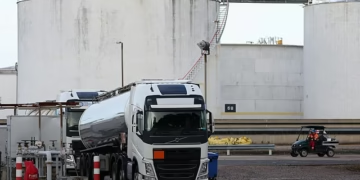
Energy markets responded to the crosscurrents of diplomatic openings and military posturing. Crude benchmarks fell to their lowest levels in more than a week during early Asian trading on Monday, driven by a partial resumption in Saudi export volumes and market expectations of mediation. Traders, however, continue to price in risk premiums tied to potential blockades in the Strait of Hormuz and the Bab el-Mandeb chokepoint.