

Three-hour sideline discussions at the UN General Assembly come alongside fresh sanctions on Iranian civil aviation and sharp rhetoric from the US president.
UNITED NATIONS, September 23, 2026 : United States and Iranian officials held three hours of mediated discussions in New York on Tuesday, testing diplomatic room for an agreement to end months of armed conflict even as President Donald Trump threatened the country with annihilation from the United Nations General Assembly rostrum.
The indirect talks, facilitated by Qatari diplomats on the sidelines of the UN General Assembly, brought together Trump envoys Steve Witkoff and Jared Kushner with an Iranian delegation led by Foreign Minister Abbas Araghchi. It was the highest-level bilateral contact between Washington and Tehran since June.
Trump described the session to reporters as a “very good meeting” and claimed there is now “a lot of momentum” toward resolving the standoff. Writing later on X, Witkoff confirmed that the two sides concluded an extensive round of mediated discussions that Washington hopes will prove “constructive and promising,” adding that mediators will continue shuttle efforts.


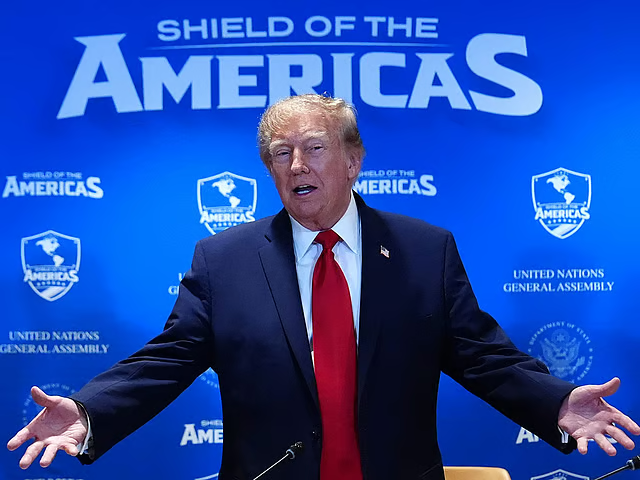
The diplomatic engagement contrasted sharply with the tone of Trump’s address to world leaders hours earlier. Speaking from the assembly podium, the US president said he faced a choice between allowing Iran to rebuild under a negotiated settlement or launching sweeping military operations to “annihilate” the Islamic Republic.

Most members of the Iranian delegation walked out of the hall as Trump branded Tehran the primary security threat in the Middle East.
At the core of Tuesday’s diplomatic track was navigation through the Strait of Hormuz, a critical bottleneck for global crude shipments. Iranian state media reported that Araghchi outlined terms under which Tehran would consider fully reopening the waterway, including an end to the US naval blockade on Iranian ports, the release of frozen financial assets, and a cessation of hostilities across regional fronts. A senior Iranian official suggested the passage could reopen swiftly if Washington initiated reciprocal de-escalation measures.
Economic pressure continued to mount concurrently. Tighter US sanctions targeting Iran’s commercial aviation sector took effect Tuesday, aiming to penalize foreign airports, refueling agents, and ground-handling providers that service Iranian civilian carriers.
Crude markets reacted to the competing signals of backchannel talks and economic enforcement, with international benchmark Brent crude hovering near $99 a barrel and US West Texas Intermediate easing slightly to around $90 a barrel as traders weighed the chances of a diplomatic breakthrough.
Iranian President Masoud Pezeshkian arrived in New York late Tuesday and is scheduled to address the General Assembly on Wednesday, where he is expected to present Tehran’s formal position on the conflict and outline conditions for any lasting diplomatic framework.