


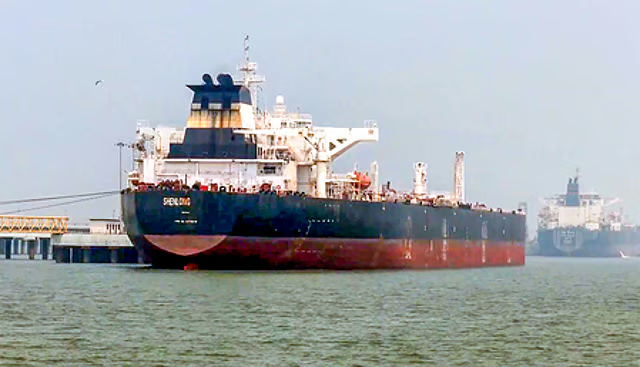
Aramco ramps up Ras Tanura loadings via shuttle corridors and ship-to-ship transfers after pipeline disruptions redirect flows back into the Strait of Hormuz.
DUBAI, Sept. 23, 2026 : Saudi Arabia logged its largest single-day crude loading surge through its primary Persian Gulf ports since hostilities escalated in the region, with commercial tankers taking on roughly 12 million barrels of crude in 24 hours.
Data from maritime tracking specialist MarineTraffic showed that six Very Large Crude Carriers (VLCCs) loaded near-capacity volumes at the Ras Tanura and Juaymah offshore marine terminals on Sept. 21. Vessel-monitoring consultancy TankerTrackers.com reported an even heavier slate, tracking seven supertankers loading roughly 14 million barrels over the same window.
The abrupt loading spike reflects state oil producer Saudi Aramco’s aggressive rerouting of supplies back through Persian Gulf choke points. Crude flows had been thrown into disarray after targeted drone strikes disrupted the 5-million-barrel-per-day East-West Petroline, the kingdom’s bypass arterial carrying eastern crude to the Red Sea port of Yanbu.


With the Yanbu overland link knocked offline, Aramco pivoted back to eastern sea lanes. Trade sources confirmed Aramco placed roughly 60 million barrels of Ras Tanura crude on the market for September and October delivery.
To bypass volatile navigation through the Strait of Hormuz, operators deployed a two-tier shuttle model: smaller tankers moved crude out of the Gulf to waters off Sohar, Oman, executing ship-to-ship (STS) transfers onto deep-draft vessels for onward transit to Asia.

Saudi maintenance teams have since finished emergency repairs on the damaged segment of the East-West pipeline, with terminal operations at Yanbu beginning phased cargo staging, including an initial supertanker bound for China.
Despite the operational rebound, regional shipping remains far from routine. Visible vessel crossings through the Strait of Hormuz dropped sharply to 17 commercial carriers over the Sept. 19–20 weekend, down from 37 vessels during the prior weekend. MarineTraffic recorded that 25 of the 26 ballast tankers entering the Gulf between Sept. 12 and 20 listed their voyage status as “Route Undetermined,” indicating vessel operators intentionally turned off AIS transponders or masked destinations to mitigate hostile interdiction.
Preliminary flow figures from vessel analytics firm Kpler show Saudi export volumes rebounded past 4 million barrels per day in mid-September, up from August’s multi-year trough of 2.4 million barrels per day.

The return of heavy volumes pulled benchmark crude futures lower during Asian trade on Wednesday. Brent crude hovered at $98.98 a barrel, down 0.27%, while West Texas Intermediate slipped 0.62% to $89.96. UAE flagship Murban crude retreated 1.23% to trade at $108.70.
While the surge eases prompt supply deficits for Asian refiners, trading desks caution that the current logistics web—reliant on costly shuttle tonnage, higher marine insurance premiums, and extended STS operations—leaves Gulf supplies structurally exposed until Red Sea routes and open transit corridors normalize completely.