


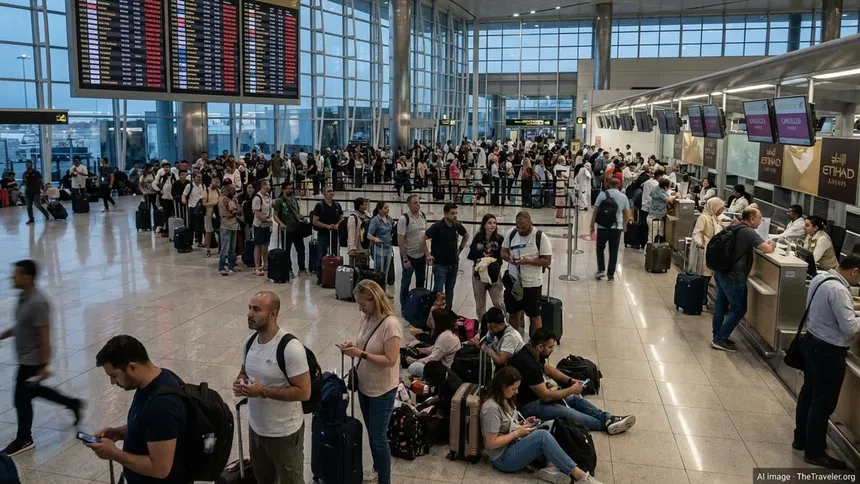
Airports in Dubai, Abu Dhabi, and Sharjah maintain core operations as airlines adjust schedules amid regional airspace curbs and routine technical constraints.
DUBAI, Sept. 26, 2026 : Airlines operating out of Dubai, Abu Dhabi, and Sharjah reported sporadic cancellations and major schedule revisions on Saturday, disrupting travel across Gulf regional routes and high-density sectors to the Indian subcontinent.
Aviation hubs across the United Arab Emirates continued regular passenger movements on Saturday, though airline schedule boards displayed severe delays alongside isolated cancellations. The operational shifts stem from a mix of regional airspace restrictions—including an indefinite freeze on Iranian carriers—and independent aircraft maintenance demands.
Dubai International Airport (DXB) logged substantial delays across budget and full-service carriers. A SpiceJet service to Kochi faced an operational pushback exceeding 16 hours, while flydubai’s scheduled early morning flight to Bangkok’s Don Mueang was delayed by roughly 17 hours. Multiple flights bound for Indian hubs including Mumbai, Ahmedabad, and New Delhi experienced rolling delays of up to two hours. On the regional front, Emirates cancelled its evening service to Amman, and an Iran Airtour flight to Tehran was scrubbed following federal directives suspending Iranian carrier operations across UAE airspace.


At Zayed International Airport in Abu Dhabi, Pakistan International Airlines cancelled its late-night flight to Islamabad. Morning departures to Indian destinations operated by Air Arabia Abu Dhabi and Etihad Airways—serving Kochi, Kozhikode, Thiruvananthapuram, and Chennai—departed roughly one hour behind schedule. Etihad’s early afternoon flight to Kochi also incurred an hour-long setback.

Regional feeder routes run by flydubai and Air Arabia faced structural schedule trimmings. Air Arabia cancelled several round-trip rotations connecting Abu Dhabi and Sharjah to Kuwait and Bahrain, alongside disruptions to Abha in Saudi Arabia. Flydubai similarly withdrew its scheduled Dubai-Abha rotation.
Aviation authorities cautioned passengers against attributing every schedule shift to geopolitical strains. Standard technical delays, staggered slot allocations, and routine operational adjustments are actively contributing to the daily variance. Furthermore, the country’s main hubs remain open, and flag carriers Emirates and Etihad Airways continue to maintain the vast majority of their global networks.

The broader aviation landscape across the region reflects a patchwork recovery. Long-haul operators have adopted varied timetables for their Gulf routes. European and Asian carriers including Air France, KLM, Swiss, and Singapore Airlines have prolonged Dubai service suspensions into late October, while Air Canada has halted operations through January 2027. Conversely, Turkish Airlines has reinstated flights into Dubai and Abu Dhabi. Phased resumptions by Lufthansa, British Airways, and Austrian Airlines remain programmed across late October into December, contingent on operational assessments.
Travel advisories issued by diplomatic missions in the United States, Britain, Canada, and Australia continue to advise caution regarding regional commercial travel. Ground handlers and airport operators urge passengers to verify booking status online before departing for terminal facilities and advise arriving at least three to four hours prior to international scheduled departures.