


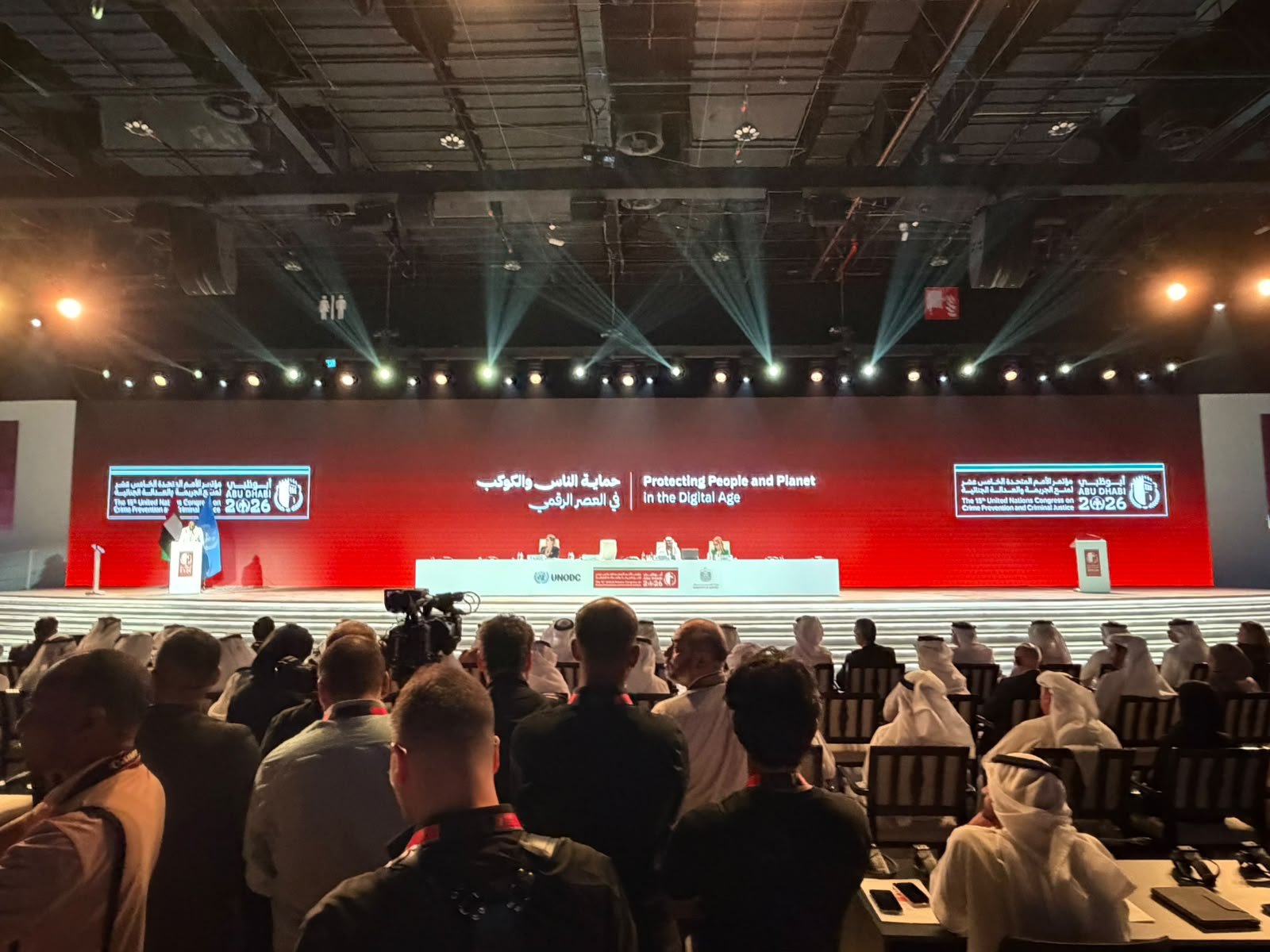
International delegates in the UAE capital push for modernized criminal justice frameworks to counter sophisticated illicit networks and weaponized technology.
ABU DHABI, Sept. 27, 2026 : Delegates at the 15th United Nations Congress on Crime Prevention and Criminal Justice stepped up calls on Sunday for sweeping international cooperation to counter organized crime, cross-border financial fraud, and crimes affecting the environment.
The second day of deliberations at the ADNEC Centre in Abu Dhabi centered on translating high-level commitments into concrete operational standards. Ministers, senior judiciary figures, and policy experts examined how rapidly evolving technologies—particularly artificial intelligence and virtual assets—are reshaping illicit operations while creating urgent demands on judicial systems worldwide.
Plenary sessions carried forward the congress’s ministerial segment alongside six thematic meetings and 22 ancillary events. Delegations also advanced technical workshops focused on expanding access to justice, accompanied by designated research roundtables hosted by the United Nations Crime Prevention and Criminal Justice Programme Network (PNI) and four Youth Lab sessions.



Discussion tracks focused heavily on closing loopholes exploited by transnational criminal enterprises. Working groups addressed the surge in cyber-enabled financial fraud, trade in illicit commodities, and money laundering schemes that route criminal proceeds through complex digital channels. Environmental degradation driven by criminal networks—including illegal logging, mining, and hazardous waste dumping—was highlighted as an escalating threat requiring harmonized legal responses across jurisdictions.

A recurring priority across panels was the dual role of artificial intelligence in rule-of-law administration. Experts emphasized that while law enforcement agencies need modern forensic and data-driven tools to investigate complex cross-border crimes, criminal justice institutions must establish clear governance mechanisms to prevent algorithmic bias and uphold human rights standards.
The congress, hosted by the United Arab Emirates, runs through October 1 under the overarching theme of protecting people and planet through strengthened legal frameworks in the digital age. Over six days, government ministers, multilateral bodies, civil society representatives, and academic researchers are drafting actionable recommendations intended to guide national policymaking and multilateral treaties for the next decade.
The outcomes negotiated throughout the week in Abu Dhabi will culminate in a comprehensive declaration setting operational benchmarks for member states to reform judicial access, dismantle organized crime syndicates, and build accountable institutions.