


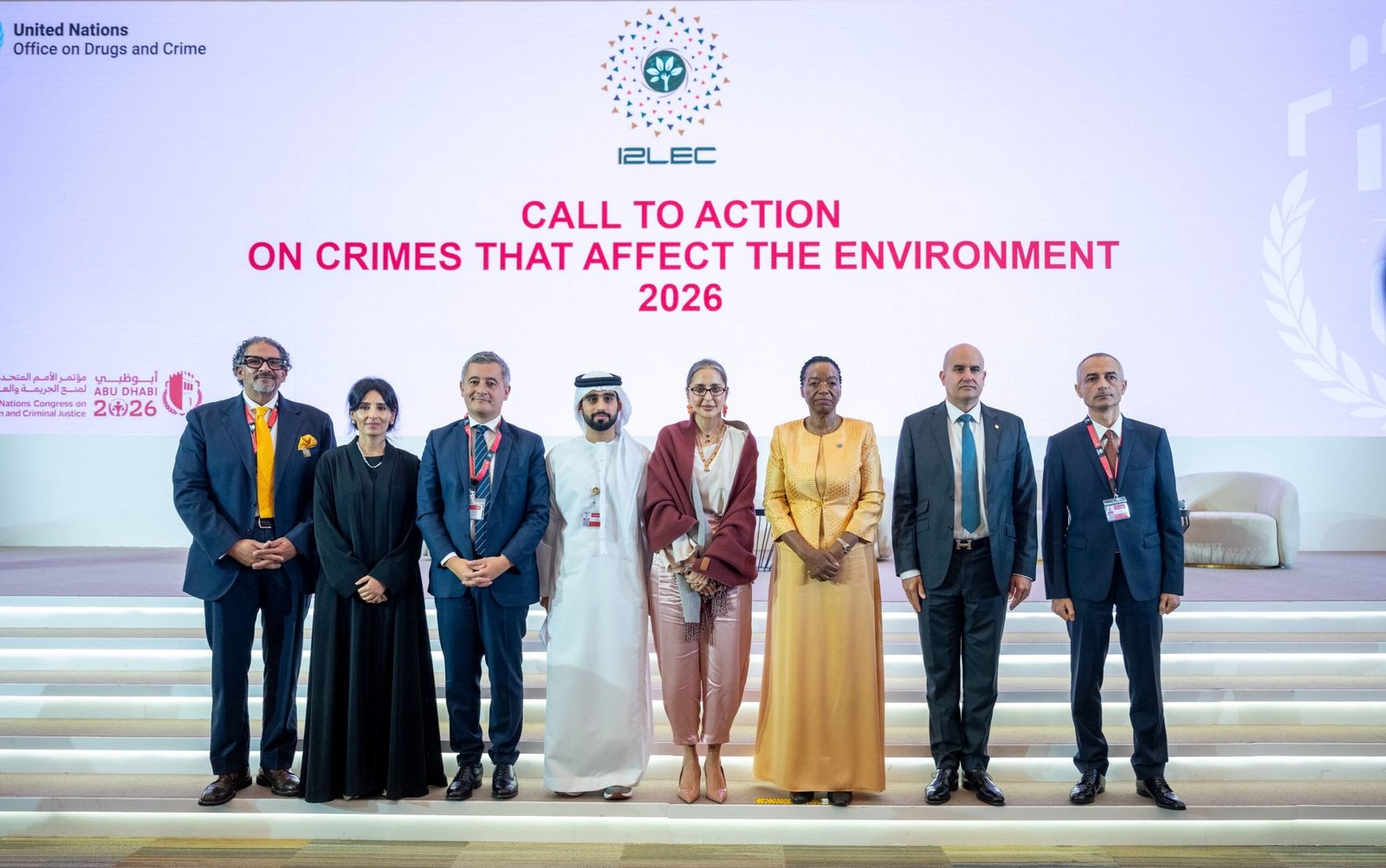
The Ministry of Interior partners with UNODC, INTERPOL, France, and Azerbaijan at the 15th UN Crime Congress, highlighting cross-border crackdowns across the Amazon Basin.
ABU DHABI — The United Arab Emirates has launched the “Abu Dhabi Call to Action,” an international enforcement roadmap urging nations to treat environmental destruction as organized cross-border crime and dismantle the global syndicates profiting from natural resource exploitation.
The initiative was unveiled during a ministerial-level forum titled “Overcoming Environmental Crime: From Promises to Tangible Results,” staged alongside the 15th United Nations Congress on Crime Prevention and Criminal Justice in the UAE capital. Convened by the UAE Ministry of Interior, the event brought together leadership from the United Nations Office on Drugs and Crime (UNODC), INTERPOL, and government delegates from France and Azerbaijan.
Colonel Dana Al Marzouqi, Director General of International Affairs at the UAE Ministry of Interior, announced the call to action, demanding a decisive shift away from non-binding diplomatic pledges toward coordinated international interdictions. She outlined the operational results of “Operation Green Shield 2026,” an enforcement sweep across South America spearheaded through the International Initiative for Law Enforcement for Climate (I2LEC)—a framework co-founded by the UAE and UNODC in 2023.


“In the UAE, our relationship with the environment is not merely a policy; it is a legacy,” Al Marzouqi said, referencing the foundational conservation ethos established by the late Sheikh Zayed bin Sultan Al Nahyan. She underlined that environmental degradation has evolved beyond localized infractions into sophisticated transnational syndicates that threaten sovereign stability.

Operation Green Shield targeted criminal syndicates entrenched across the Amazon Basin, hitting illicit supply chains tied to wildcat gold mining, illegal logging, wildlife trafficking, fuel smuggling, and systemic land seizures. Al Marzouqi noted that I2LEC provided intelligence coordination, training, and operational backing to South American police forces to breach these networks.

Ghada Waly, Executive Director of the UNODC, warned that environmental destruction has become a primary revenue driver for organized crime cartels. These groups regularly channel their illicit revenues through the same logistical corridors used for narcotics, weapons, and human trafficking.
“While the commodities and markets may vary, the underlying criminal model remains the same,” Waly told delegates. She pointed out that while comprehensive legal treaties exist, global enforcement remains hamstrung by uneven judicial capabilities and inadequate cross-border intelligence pooling.
French Justice Minister Gérald Darmanin called for aggressive tracking of the financial machinery feeding environmental degradation, emphasizing that law enforcement must pursue illicit proceeds and money laundering operations tied to resource theft.
INTERPOL representative Lucas Philippe stressed the operational hurdles front-line agencies face against syndicates spanning multiple jurisdictions, calling for uniform digital tracking systems to dismantle trafficking routes. Addressing judicial bottlenecks, Vugar Aliyev of Azerbaijan’s Prosecutor General’s Office urged states to equip specialized prosecutors with the statutory tools needed to secure convictions against transnational cartels.
Razan Khalifa Al Mubarak, President of the International Union for Conservation of Nature (IUCN), who moderated the assembly, concluded that preserving biodiversity hinges entirely on whether police and justice ministries treat environmental cartels with the same urgency as conventional organized crime.