


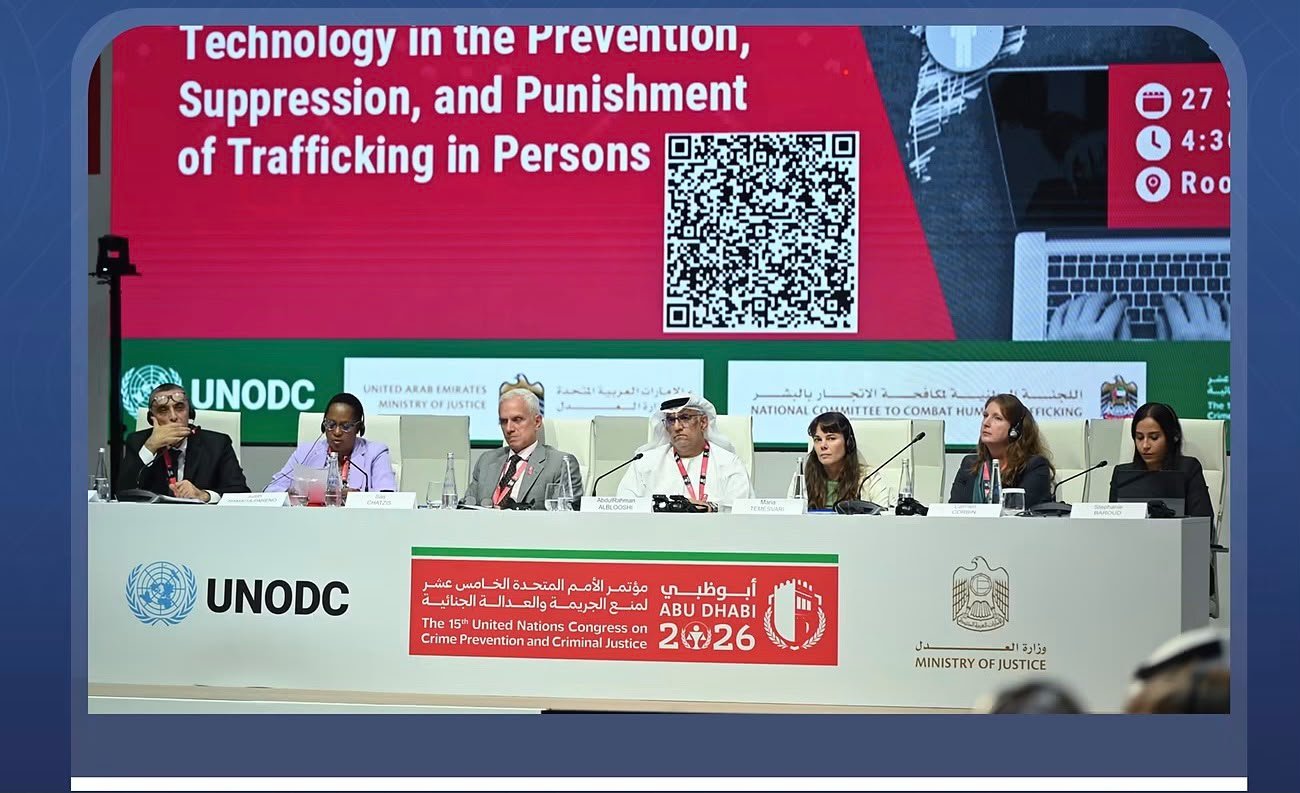
Unveiled at the UN Crime Congress in Abu Dhabi, the centralized digital network links 14 state entities to identify victims early and accelerate cross-border prosecutions
ABU DHABI, Sept. 29: The United Arab Emirates has rolled out a unified national digital framework powered by artificial intelligence to track human trafficking syndicates, intervene before victims face re-exploitation, and coordinate multi-agency prosecutions, officials announced at the 15th United Nations Crime Congress.
Presented during a high-level session at the 15th United Nations Congress on Crime Prevention and Criminal Justice in the capital, the platform connects 14 federal ministries and public entities, giving roughly 200 accredited specialists immediate access to analytical tools and cross-jurisdictional intelligence.

Organized in collaboration with the United Nations Office on Drugs and Crime (UNODC) for the GCC region, the session focused on deploying algorithmic threat-detection and integrated data systems against increasingly sophisticated digital trafficking networks. Criminal syndicates now routinely exploit encrypted messaging, deceptive job portals, and online financial platforms to lure and control individuals across borders.


Abdulrahman Murad Al Blooshi, Vice Chair of the National Committee to Combat Human Trafficking (NCCHT), told delegates that the nation’s response rests on safeguarding fundamental human dignity through a five-pillar strategy: prevention, prosecution, punishment, survivor protection, and international cooperation.
The proprietary digital architecture runs automated risk-assessment protocols, spots emerging crime patterns, and initiates immediate multi-agency notifications whenever vulnerable individuals—particularly women, children, and people of determination—are identified.

Beyond active detection, the system continuously logs protective interventions, managing medical evaluations, legal referrals, shelter placement, and monitored repatriation pipelines to ensure survivors are not abandoned or re-traumatized once liberated from exploitation networks.
Criminal networks have retooled their operations to mirror tech enterprises, weaponizing virtual assets, forged electronic visas, and offshore servers to obscure recruitment and money-laundering channels. Combating this scale of decentralized crime requires public institutions to operate at a higher technical standard than the cartels they pursue.
The UAE was among the first regional states to ratify the Palermo Protocol, the primary international benchmark against human trafficking. In recent years, the Gulf nation updated Federal Law No. 51 of 2006 to expand criminal classifications, mandate state-backed legal assistance for victims, and introduce stiffer penalties for coercive recruitment tactics.
The deployment reflects the broader operational goals of the Abu Dhabi Declaration emerging from this year’s UN Congress, which emphasizes cross-border data-sharing, responsible deployment of judicial artificial intelligence, and victim-centered criminal justice.
Federal law enforcement authorities and international partners are scheduled to initiate regional data-sharing protocols next quarter to streamline intelligence exchanges on trafficking rings operating across global transit corridors.