


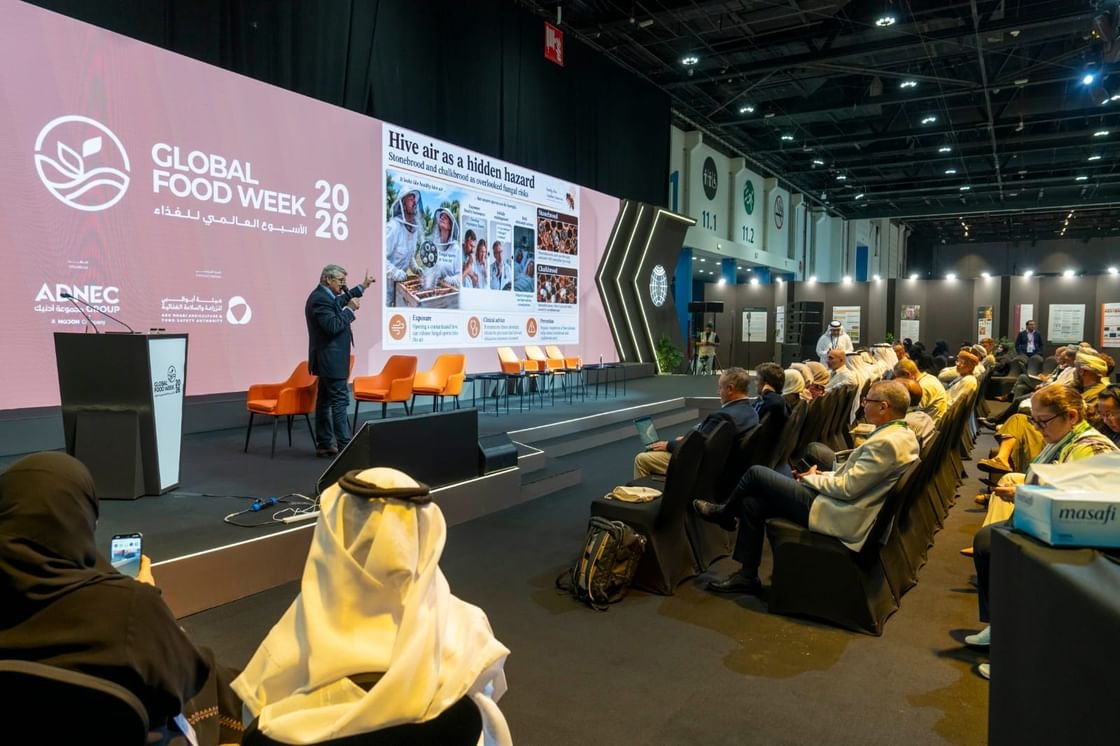
Day two of Global Food Week 2026 brings together international policymakers, investors, and agribusiness leaders at ADNEC Centre Abu Dhabi to address mounting pressures on regional agrifood systems.
ABU DHABI, Oct. 7, 2026 : Ministers, food security experts, and agricultural innovators gathered at ADNEC Centre Abu Dhabi on Wednesday for the second day of Global Food Week 2026, closing out the two-day Global Food Security Summit with urgent calls to modernize regional food supply chains and deploy artificial intelligence in agriculture.
The high-level gathering, held under the patronage of Sheikh Mansour bin Zayed Al Nahyan, Vice President, Deputy Prime Minister, and Chairman of the Abu Dhabi Agriculture and Food Safety Authority (ADAFSA), centered on practical measures to safeguard food systems against climate volatility and supply shocks.

Discussions at the concluding sessions of the Global Food Security Summit zeroed in on the deployment of artificial intelligence, digital logistics, sustainable water management, and the flow of private capital into agricultural infrastructure. Delegates from multilateral lenders, research institutes, and agribusiness firms examined the structural shifts required to keep pace with population growth across import-dependent regions.


At the Food and Agriculture Organization (FAO) Policy Majlis, regional leaders analyzed the compounding pressures facing Middle Eastern and North African food networks. Moderating a panel titled “Agrifood Systems under Pressure: Evidence and Opportunities,” Ahmad Mukhtar, FAO Representative in the UAE and Subregional Coordinator for the GCC States and Yemen, stressed the importance of data-backed decision-making and de-risking private investments to attract sustained capital into regional farming. Panelists noted that water scarcity, shipping disruptions, and economic turbulence require systemic responses, including targeted youth training and institutional support for modern farming techniques.
Domestic agricultural capacity took center stage at the Farmers Majlis, where Emirati growers met with government specialists to discuss operational challenges and input costs. Across the hall, the AgriTech Forum displayed controlled-environment agriculture, automated irrigation systems, and soil-regeneration research designed to curb water consumption in arid environments. ADAFSA officials framed these platforms as essential to the UAE’s broader national strategy to raise local production targets while insulating supply chains from international freight bottlenecks.

Commercial deal-making proceeded alongside policy talks through the Hosted Buyers Programme, which organized structured meetings between commercial farm operators, food processors, and global procurement teams. Organizers reported steady deal flow across commodity imports, agritech licensing, and distribution agreements spanning the GCC and wider Asian markets.
Exhibition floors drew trade visitors and consumers with live programming, including the debut Beverage Zone, which hosted specialized masterclasses focusing on roasting profiles, specialty coffees from Ethiopia, matcha brewing, and traditional karak. At the World Gourmet Show, professional chefs demonstrated culinary techniques and sustainable ingredient sourcing, preparing dishes ranging from classic Italian porcini and truffle risottos to contemporary pizzas.
Global Food Week 2026 enters its third day on Thursday, Oct. 8, with sessions scheduled on international regulatory alignment, bio-security protocols, and cold-chain infrastructure across the Middle East.