


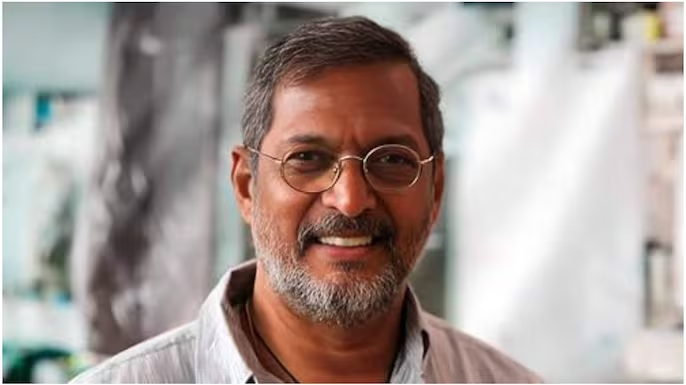
The three-time National Award winner was pronounced dead after suffering sudden chest pain; condolences pour in across cinema and politics.
PANAJI, Oct. 8, 2026 : Nana Patekar, the towering actor whose volatile screen presence, acerbic delivery, and philanthropic work defined a distinct chapter of Indian cinema, died early Thursday morning at his residence in Goa. He was 75.
Doctors at Manipal Hospital in Goa declared the veteran actor dead at 5:20 a.m. after emergency medical responders failed to revive him at his apartment.
His son, Malhar Patekar, said the actor alerted family members to sharp chest pain during the early hours of Thursday. A medical team rushed to his residence found him unresponsive. Paramedics initiated CPR at the scene and during transport, but physicians at the hospital confirmed he could not be resuscitated. A post-mortem examination is scheduled for later today.




Patekar’s death ends a prolific, five-decade career that traversed parallel cinema, mainstream commercial Hindi blockbusters, and Marathi theater. Known for an intense, staccato dialogue delivery and an uncompromising artistic persona, Patekar captured three National Film Awards and stood among the few performers capable of shifting effortlessly from terrifying villainy to biting satire.
Born Vishwanath Patekar in Murud-Janjira, Maharashtra, he graduated from the Sir J.J. Institute of Applied Art in Mumbai and worked in advertising before finding his calling on the stage. His feature film debut arrived in Muzaffar Ali’s 1978 drama Gaman.
National prominence followed over the next decade. His chilling portrayal of the underworld henchman Anna Seth in Vidhu Vinod Chopra’s Parinda (1989) earned him his first National Film Award for Best Supporting Actor. He collected his second National Award—this time for Best Actor—playing an obsessive, hot-tempered man in Krantiveer (1994), whose climatic anti-communal monologue remains a cultural touchstone. Patekar earned a third National Award for his supporting role in the 1997 film Agnisakshi.
Directors prized Patekar for his realism and raw grit. In Shimit Amin’s procedural thriller Ab Tak Chhappan (2004), he delivered a brooding, unsparing depiction of Mumbai encounter specialist Sadhu Agashe. Similar depth anchored his turns in Shakti: The Power (2002), Prakash Jha’s Apaharan (2005), and Milan Luthria’s Taxi No. 9211 (2006).
Later generations discovered his comic instincts. In Anees Bazmee’s 2007 blockbuster Welcome, Patekar’s portrait of Uday Shetty—an organized crime boss desperate to become an art-house actor—became an instant pop-culture phenomenon, a role he reprised in the 2015 sequel Welcome Back. His dramatic prowess returned to full force in the 2016 Marathi milestone Natsamrat, directed by Mahesh Manjrekar, where his portrayal of an aging Shakespearean actor won sweeping critical acclaim. More recently, he was seen on screen in Housefull 5.
Beyond cinema, Patekar was deeply engaged in rural welfare. In 2015, alongside Marathi actor Makarand Anaspure, he established the Naam Foundation, a charitable trust providing financial relief, water conservation infrastructure, and psychological support to drought-hit farmers across Maharashtra.
Tributes began circulating within minutes of the announcement.
Director Ram Gopal Varma expressed grief on social media platform X, describing Patekar’s sudden passing as an unfathomable loss for cinema. Fellow actor Prakash Raj reflected on personal moments spent together, writing of his fond memories of Patekar’s warmth, intellect, and home cooking.
Riteish Deshmukh, who co-starred with him in Bluffmaster! and Housefull 5, called the death the “end of an era,” noting that Patekar’s greatness on screen was matched by his humanitarian work behind the scenes.
Uttar Pradesh Chief Minister Yogi Adityanath paid tribute to Patekar’s artistic and social contributions, praising the Padma Shri recipient’s enduring commitment to society alongside his cinematic brilliance.
Funeral arrangements and public memorial schedules will be released by the family following the completion of medical formalities in Goa.