

Three-day summit draws over 47,000 visitors as 97 commercial agreements drive investments in arid agriculture, agritech, and regional supply chains.
ABU DHABI — Commercial transactions worth AED 6.9 billion ($1.88 billion) were signed across three days at Global Food Week 2026, marking a 5% increase in contract value over the previous edition as Gulf economies accelerate agricultural investment.
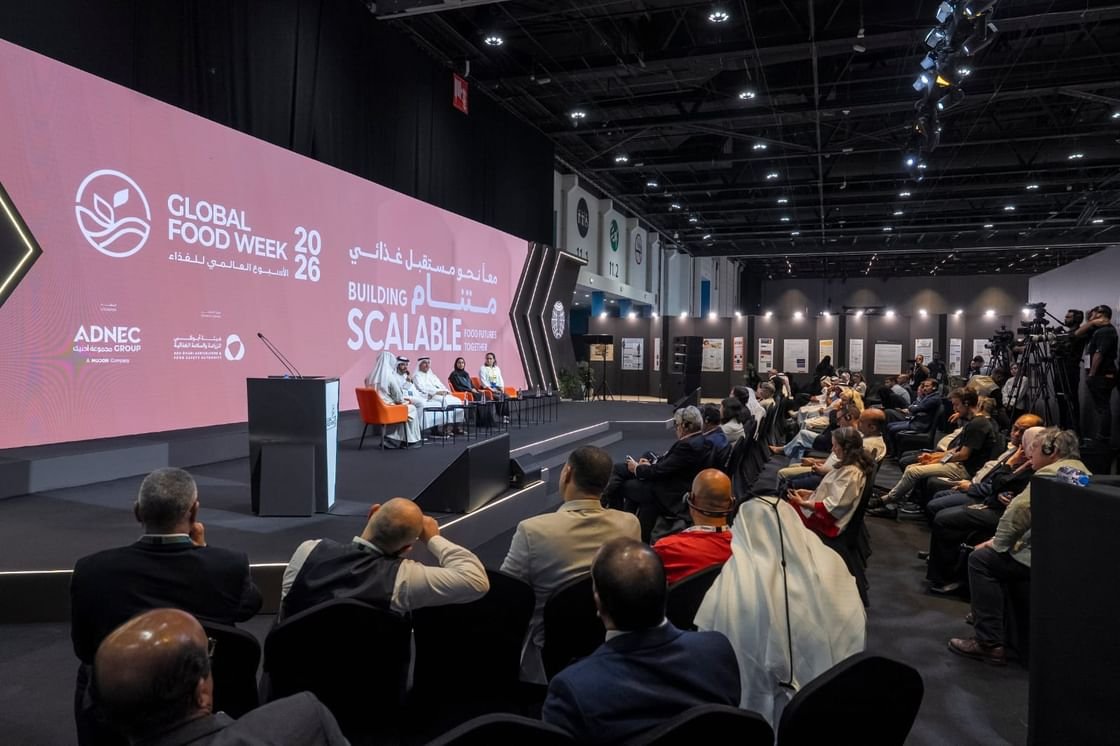
The international trade exhibition and policy summit concluded at the Abu Dhabi National Exhibition Centre with 97 commercial agreements, drawing 47,092 attendees and cementing the emirate’s push to build resilient food supply networks in arid climates.

Organised by ADNEC Group in partnership with the Abu Dhabi Agriculture and Food Safety Authority (ADAFSA), the three-day gathering brought together 2,580 exhibitors from 92 countries. Total attendance climbed 17% compared with 2025, buoyed by the introduction of a public retail segment, “Shop at the Show,” which allowed direct consumer sales alongside corporate procurement.


The event took place under the patronage of Sheikh Mansour bin Zayed Al Nahyan, Vice President, Deputy Prime Minister, Chairman of the Presidential Court, and Chairman of ADAFSA’s Board of Directors.
Domestic companies comprised 67% of participating exhibitors, with foreign firms making up the remaining 33%. Small and medium-sized enterprises represented nearly a quarter of all booths, supported by a newly launched SME pavilion designed to pair emerging food producers with international retail buyers and commercial farm operators.
Dr. Tareq Ahmed Al Ameri, Acting Director-General of ADAFSA, noted that cross-border cooperation remains essential to counter the twin pressures of water stress and trade disruption.
“The challenges facing global food systems, from climate change and water scarcity to supply chain disruptions, extend beyond national borders and require solutions based on international cooperation,” Al Ameri said. ADAFSA’s objective centers on establishing agricultural models that can withstand climatic shifts while stabilizing domestic food supplies.

Humaid Al Dhaheri, Group CEO of ADNEC Group, attributed the record deal volumes to strong international participation and targeted commercial matchmaking.
“Beyond the commercial results, Global Food Week has become a platform for exchanging knowledge,” Al Dhaheri said, pointing to expanded conference tracks that brought together policymakers, agricultural scientists, and institutional investors.
Trade discussions ran parallel to specialized technical events. The 12th Abu Dhabi Date Palm Exhibition, held with the Khalifa International Award for Date Palm and Agricultural Innovation, featured 100 exhibitors from 12 countries, highlighting tissue-culture advancements, automated harvesting, and pest-control technologies.
Beekeeping in desert climates took center stage at the inaugural Abu Dhabi Honey Symposium, organised with the International Federation of Beekeepers’ Associations (Apimondia). Delegates focused on selective breeding for heat tolerance and habitat preservation across the Middle East and North Africa.
Technology showcases at the AgriTech Forum focused on practical deployment in desert conditions. Engineers and researchers demonstrated closed-loop hydroponics, AI-monitored drip irrigation, and soil amendments capable of retaining moisture in sandy ground. Discussions on the closing day centered on harmonizing biosecurity standards and expanding refrigerated cold-chain networks across Middle Eastern transit corridors.