

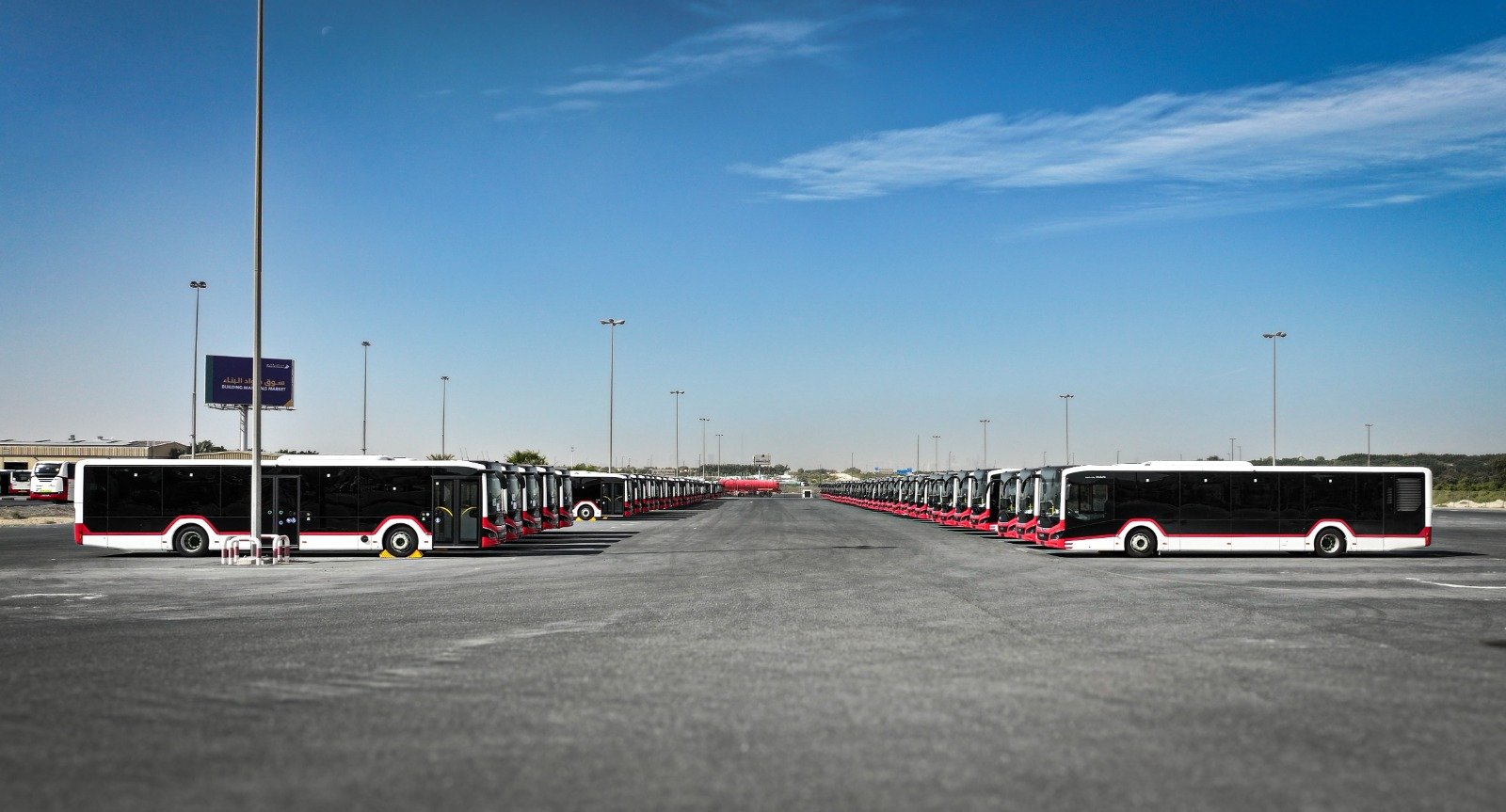

Dubai’s Roads and Transport Authority (RTA) has announced the arrival of the first batch of 250 new buses under a contract to procure 735 multi-size buses that comply with the European low-carbon emissions standard Euro 6. The batch includes 40 electric buses, marking the largest and first-of-its-kind deployment of electric buses in the UAE. Delivery of the remaining buses is scheduled to be completed during 2026.
His Excellency Mattar Al Tayer, Director General and Chairman of the Board of Executive Directors of RTA, inspected the Zhongtong electric bus, which will be operated for the first time on Dubai’s urban routes. The electric bus has been specifically designed to suit Dubai’s operating conditions, offering an operating range of up to 280 kilometres on a single charge, allowing it to complete daily services without returning to depots for recharging. It features a battery capacity of 434 kilowatt-hours, supported by a 360-kilowatt ABB charger.
During the inspection, His Excellency was briefed on the bus specifications, including its 12-metre length, capacity for 70 passengers, and a 360-degree camera system. The bus meets international safety standards and holds global certifications. It is equipped with an advanced battery-cooling system designed for the UAE climate. The vehicle underwent more than three months of testing in Dubai, achieving positive results across inspection and trial-operation phases. Tests confirmed the stability and efficiency of the electric propulsion system, safety of critical components such as the battery, cooling and braking systems, and strong operational performance in energy efficiency, braking response, air-conditioning, and vehicle stability. The trials recorded a 95% satisfaction rate among drivers and passengers.



His Excellency Mattar Al Tayer stated that the procurement of the new buses aligns with the directives of His Highness Sheikh Mohammed bin Rashid Al Maktoum, Vice President and Prime Minister of the UAE and Ruler of Dubai, and the follow-up of His Highness Sheikh Hamdan bin Mohammed bin Rashid Al Maktoum, Crown Prince of Dubai, Deputy Prime Minister, Minister of Defence and Chairman of the Executive Council of Dubai. These directives aim to establish a sustainable and flexible public transport system that supports daily mobility, enhances quality of life, strengthens Dubai’s global competitiveness, and supports the objectives of the Dubai Urban Plan 2040.
Al Tayer noted that the initiative forms part of RTA’s integrated strategic plan to advance public transport in line with global best practices, encourage greater use of public transport, and keep pace with the continuous growth in ridership, making public transport the preferred choice for residents.

He added that the number of electric buses operating across the Emirate will increase gradually in line with national objectives to reduce the carbon footprint and achieve climate neutrality by 2050, and in support of the Dubai Economic Agenda D33. These efforts also align with RTA’s Zero-Emission Public Transport Strategy 2050, which aims to convert all buses, taxis and limousine vehicles to zero-emission operation, transitioning 100% of public transport buses to electric and hydrogen power by 2050.
The contract includes the procurement of 40 Zhongtong electric buses, as well as 549 city-service buses comprising 400 MAN buses and 149 Zhongtong buses, all built to high standards of safety, comfort and quality. In addition, the contract covers 76 double-decker Volvo buses and 70 articulated Isuzu Anadolu buses to serve high-density urban areas and newly developed districts, expanding service coverage and increasing occupancy rates.
Most of the new buses are equipped with advanced smart systems, including Driver Behaviour Monitoring Systems, Automated Passenger Counting systems to reduce fare evasion, and Driver Identity Authentication systems integrated with operational platforms. The buses also feature ergonomic seating, seat belts in family-designated areas, low-floor entrances for People of Determination, bicycle spaces, Wi-Fi services, mobile charging points, and modern interior designs reflecting Dubai’s contemporary identity. A national standardised fuel-consumption testing protocol—the first of its kind in the Gulf region—has also been adopted to enhance operational efficiency and environmental sustainability.