


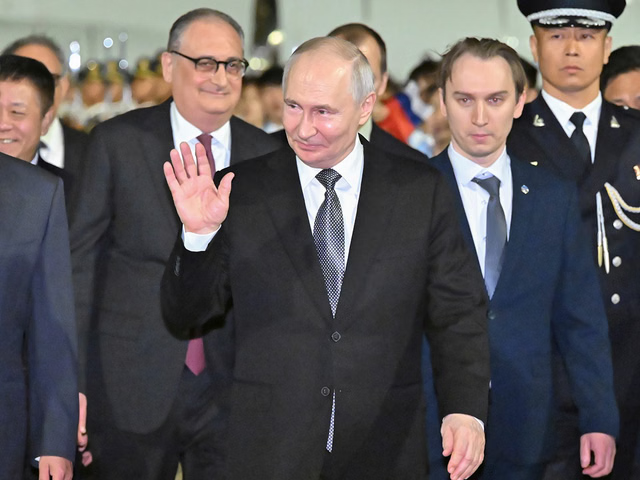
BEIJING – Russian President Vladimir Putin arrived in Beijing on Wednesday to meet Chinese President Xi Jinping, a high-stakes summit aimed at projecting a united, unshakeable alliance. The meeting comes immediately on the heels of US President Donald Trump’s state visit to China and unfolds against a backdrop of fracturing Middle East security, marked by a paused US military strike on Iran, a tightening maritime blockade, and international condemnation over a drone attack targeting a UAE nuclear facility.
The Moscow-Beijing Axis Realigns
President Putin’s arrival in the Chinese capital carries significant geopolitical weight. While President Trump was received in Beijing last week with immense pomp, his visit concluded without major breakthroughs on critical global security fronts, including securing Chinese assistance in reopening the volatile Strait of Hormuz.
For Putin, the summit offers an opportunity to reinforce economic and strategic ties with the world’s second-largest economy. The Russian leader enters these talks navigating prolonged economic pressure from Western sanctions tied to the war in Ukraine, which continue to squeeze Russia’s vital energy revenues. By reinforcing their alliance, Moscow and Beijing look to establish a formidable counterweight to Washington’s unilateral diplomatic and military maneuvers.


Trump’s ‘Limited’ Window for Diplomacy
In Washington, President Trump revealed he narrowly averted a direct military confrontation with Tehran, pausing a planned aerial assault just an hour before execution. Trump indicated the delay is strictly temporary—potentially lasting only until the weekend or early next week—to allow a final window for ongoing diplomatic negotiations.

“We can’t let them have a new nuclear weapon,” Trump stated, emphasizing that the threat of an imminent military strike looms large if talks fail to yield immediate concessions.
Underscoring the severity of the administration’s stance, US Central Command (CENTCOM) confirmed that naval forces are strictly enforcing a total maritime blockade on Iranian shipping. CENTCOM reported that 89 commercial vessels have already been intercepted and redirected to halt the flow of traffic into and out of Iranian ports, crippling Tehran’s maritime commerce.
Internal Fractures and Nuclear Security Risks
The prospects of a diplomatic breakthrough remain highly volatile. US Vice President JD Vance expressed deep skepticism regarding Iran’s readiness to commit to a deal, citing evident “fractures” within Tehran’s political leadership. According to Vance, mixed signals emanating from competing power centers inside Iran have left the country’s actual negotiating position unclear, though he noted the US remains sufficiently optimistic to sustain diplomatic channels alongside active military pressure.

The urgency of the regional crisis was further highlighted at the United Nations. The UN Security Council issued a sharp, unified condemnation following a terrorist drone attack targeting the UAE’s Barakah Nuclear Power Plant. The UAE joined council members in demanding absolute accountability for the strike, with international officials warning of the catastrophic global risks associated with targeting active civilian nuclear infrastructure.
As the Middle East balances precariously between an all-out regional conflict and a fragile diplomatic resolution, the meeting between Putin and Xi introduces a critical wildcard into the global calculus, signaling that any resolution in the Gulf will require navigating a deeply divided landscape of global superpowers.