


Sharjah’s Guest of Honour programme highlights shared literary traditions, memory, history, and the future of children’s literature
WARSAW, May 31, 2026: Literature’s unique ability to transcend borders and connect people across cultures took centre stage at the Warsaw International Book Fair 2026, where Sharjah’s Guest of Honour programme brought together Emirati and Polish authors for a series of thought-provoking discussions on storytelling, memory, identity, and children’s literature.
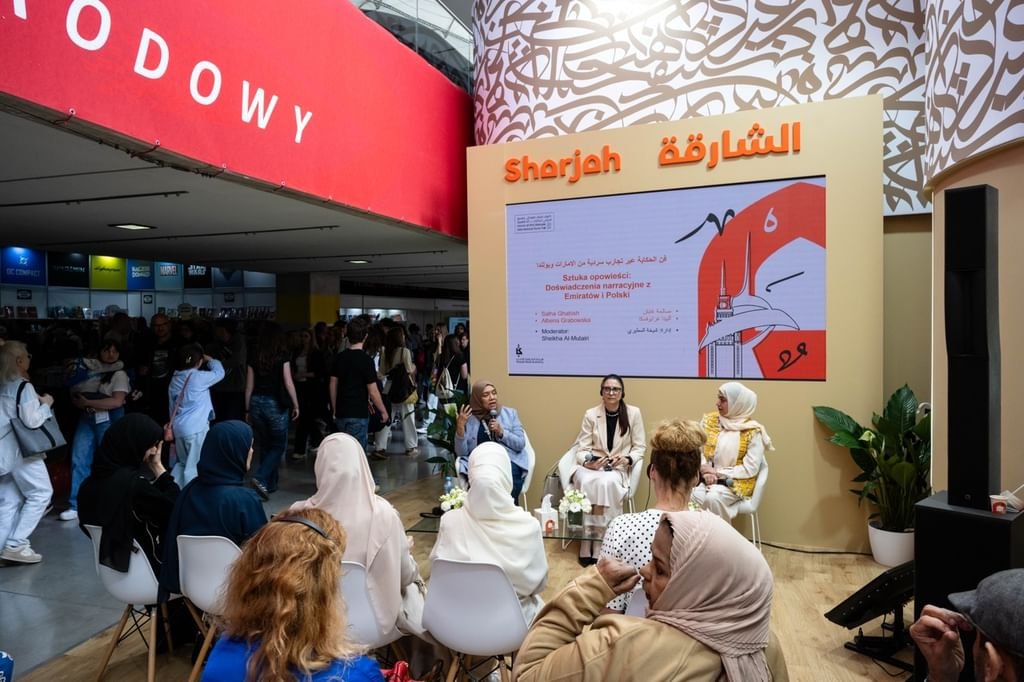
The Sharjah pavilion hosted a panel titled “The Art of Storytelling through Narrative Experiences from the UAE and Poland,” featuring Emirati writer Saleha Ghabesh and Polish novelist Albena Grabowska. The discussion explored how stories deeply rooted in local experiences can resonate with readers worldwide through universal emotions and shared human experiences.
Reflecting on the role of memory in literature, Ghabesh noted that while memory often forms the foundation of fiction, it is ultimately shaped by the writer’s language, culture, and creative vision.



“The most local stories are often the ones that travel the furthest,” she said, emphasizing that authenticity allows literature to cross cultural and geographical boundaries.
Grabowska echoed similar sentiments, describing storytelling as an extension of the collective memory of women, families, and communities. She explained that much of Polish literature emerges from what she called “small homelands”—the places where people grow up and where memories are preserved and passed through generations.

The Polish novelist also highlighted the complexities of literary translation, arguing that translation involves more than simply converting words from one language to another. It requires preserving cultural nuances and deeper meanings while making stories accessible to new audiences.
Exploring Memory, History and Identity
Another session, titled “The Diversity of Human Experiences in Emirati and Polish Fiction,” featured Emirati poet and novelist Dhaen Shahin alongside Polish novelist Wit Szostak.
The discussion focused on how fiction serves as a powerful medium for preserving both individual and collective memory while reinterpreting history through personal narratives. The speakers examined the role of literature in helping societies understand identity, social transformation, and cultural evolution.
Both authors stressed that culture remains one of the strongest bridges between nations and communities. They noted that novels, short stories, historical accounts, and cultural studies collectively form a shared intellectual heritage that encourages dialogue and understanding across geographical and cultural divides.
Children’s Literature Faces Digital-Era Challenges
The programme also turned its attention to children’s literature and the challenges faced by authors in an increasingly digital world.
In a session titled “Children’s Literature in the United Arab Emirates and Poland: Between Innovation and Renewal,” Emirati author Nadia Al Najjar and Polish writer Barbara Kosmowska discussed changing reading habits among young audiences and the growing influence of technology.
Al Najjar emphasized that successful writing for children begins with understanding the interests, language, and concerns of each age group. She noted that one of the greatest challenges for contemporary children’s authors is creating original and engaging stories that can compete with the constant distractions of digital devices and online content.
Kosmowska observed that similar challenges exist in Poland, where books no longer occupy the central place they once held in children’s daily lives. She added that parents continue to play a crucial role in shaping reading habits and introducing children to the world of books and storytelling.
Strengthening Cultural Dialogue Through Literature
The discussions at the Sharjah pavilion underscored literature’s enduring power to connect cultures, preserve memories, and foster dialogue across borders. By bringing together voices from the UAE and Poland, the programme highlighted shared human experiences while celebrating the richness and diversity of both literary traditions.
As Sharjah continues to strengthen its global cultural presence, its participation as Guest of Honour at the Warsaw International Book Fair reflects a broader commitment to promoting cultural exchange, literary collaboration, and mutual understanding through the universal language of storytelling.