

Baghdad targets pipelines through Turkey and new routes across Syria to bypass the blocked Persian Gulf chokepoint as southern production drops by three million barrels per day.
DUBAI — Iraq is moving to sharply increase crude oil exports through northern and western overland routes as a prolonged shipping disruption through the Strait of Hormuz continues to severely undermine the country’s oil-dependent economy.
The Iraqi cabinet has approved fast-tracked infrastructure plans to more than triple crude exports through the Kurdistan-Turkey pipeline network. Under the new directive, shipments are projected to rise from the current 220,000 barrels per day (bpd) to 770,000 bpd within the next two and a half months. This strategy aims to secure an immediate alternative to the country’s southern maritime terminals in the Persian Gulf, which have been rendered largely inaccessible by regional hostilities.
Hormuz Disruption Halts Southern Exports
The aggressive expansion comes as Baghdad faces mounting financial pressure from the effective closure of the Strait of Hormuz, one of the world’s most critical energy chokepoints. Following the outbreak of conflict involving the United States, Israel, and Iran earlier this year, maritime traffic through the waterway has plummeted.


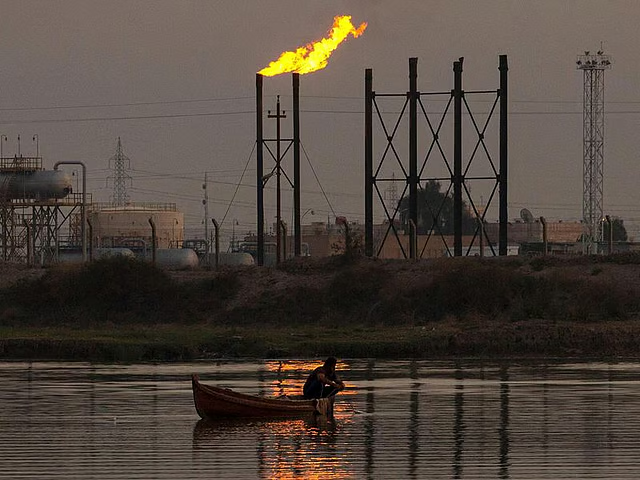
Unlike regional neighbors such as Saudi Arabia and the United Arab Emirates, which operate extensive pipeline networks to coastlines outside the Persian Gulf, Iraq possesses limited infrastructure capable of bypassing the strait. As exports from the southern Basra terminals stalled, regional storage facilities and anchored tankers filled to maximum capacity, forcing Baghdad to implement drastic production cuts.
Average output from Iraq’s southern oil fields has fallen to approximately 1.3 million bpd, down from nearly 4.3 million bpd before the outbreak of hostilities.
Economic Vulnerability Exposed
The export collapse highlights Iraq’s extreme vulnerability to energy market disruptions. Crude oil revenues account for roughly 90% of the Iraqi state budget, making it one of the most oil-dependent economies in the Middle East. Decades of stalled economic diversification initiatives have left public finances fully exposed to geopolitical shocks.

Official data underscores the scale of the downturn. Oil Minister Basim Muhammad Khudhair confirmed that Iraq exported just 10 million barrels through the Strait of Hormuz in April, compared to 93 million barrels in the month immediately preceding the conflict.
Furthermore, vessel-tracking data indicates that only two tankers loaded crude at Iraq’s southern export terminal in April, down from 12 in March. Under normal operating conditions, the port typically services up to 80 tankers per month.
       NORMAL VS. CURRENT SOUTHERN EXPORTS (APRIL 2026)

Normal Monthly Tankers:  [========================================] 80
April Actual Tankers:    [=] 2
Diversifying Routes Across Turkey and Syria
The newly approved 770,000 bpd target via Turkey surpasses an earlier government estimate of 500,000 bpd. This route transports crude from the Kirkuk and Kurdistan fields directly to Turkey’s Mediterranean port of Ceyhan. Operations along the line resumed in March following a breakthrough revenue-sharing agreement between Baghdad and the Kurdistan Regional Government (KRG).
In tandem with the pipeline expansion, the government has approved plans to scale up crude shipments by truck to neighboring countries to 420,000 bpd, a significant increase from previous capacities estimated between 100,000 and 200,000 bpd.
Furthermore, following bilateral discussions with Syrian authorities, Baghdad has approved a proposal to revive transit routes toward Syria’s Mediterranean ports of Baniyas and Tartus. Expected export volumes for the Syrian corridor have not yet been disclosed.

Steep Discounts Fail to Attract Buyers
To maintain sales from its constrained southern fields, the State Oil Marketing Organization (SOMO) has resorted to aggressive price incentives. SOMO is currently offering historic discounts of up to $33.40 per barrel on Basrah Medium crude and up to $30 per barrel on Basrah Heavy crude against official selling prices.
However, these deep discounts reflect the severe logistical hazards facing international buyers. Tankers must still enter the conflict-affected waters of the Persian Gulf to load these cargoes. SOMO’s sales notices explicitly state that force majeure provisions will not apply, requiring buyers to absorb all operational and security risks.
With diplomatic efforts yet to yield a breakthrough in the regional conflict, Iraqi officials acknowledge that fiscal stability will remain entirely dependent on how quickly these alternative northern and western land corridors can be brought online.