


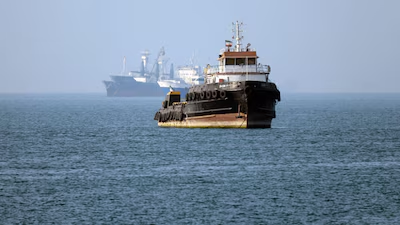
President Donald Trump denounces Iran’s strike on a commercial vessel as a “foolish violation” of a week-old ceasefire, prompting retaliatory airstrikes by US Central Command.
DUBAI: The United States military launched targeted airstrikes against multiple Iranian missile and drone storage sites on Friday, June 26, 2026, following a drone attack on a commercial cargo ship transiting the critical Strait of Hormuz. US Central Command (CENTCOM) confirmed the operation, characterizing the swift response as a necessary retaliation against what Washington labeled an unprovoked violation of a recently brokered ceasefire agreement.
The military action came hours after the Singapore-flagged cargo vessel M/V Ever Lovely was struck by an Iranian one-way attack drone along the Omani coast while exiting the Strait of Hormuz. US President Donald Trump blamed Tehran for launching at least four drones during the incident, calling the assault a “foolish violation” of the bilateral memorandum of understanding signed on June 17. “The unwarranted aggression against commercial shipping by Iranian forces clearly violated the ceasefire,” CENTCOM stated, noting that American aircraft focused their strikes on coastal radar infrastructure alongside missile hubs.




Following the American air campaign, which primarily hit assets near the southern Iranian port of Sirik, Iran’s Islamic Revolutionary Guard Corps (IRGC) reportedly retaliated by targeting US military positions in the region. The IRGC issued a warning through state media, threatening a far broader response should the United States repeat any military aggression on Iranian territory.
The escalating crossfire represents the most severe trial yet for the fragile, U.N.-backed interim understanding designed to end a months-long maritime conflict and reopen the vital shipping passage. Following the drone strike, the International Maritime Organization (IMO) temporarily halted operations aimed at evacuating hundreds of stranded ships from the waterway, citing a lack of safety guarantees.
The Geopolitical Gridlock in the Strait of Hormuz: The Strait of Hormuz remains the world’s most critical chokepoint for global energy and trade flows, through which a significant portion of the world’s crude oil passes. A major conflict in the region previously shut down traffic through the strait, triggering a spike in global commodities, fuel, and fertilizer prices. While the 60-day interim agreement signed in mid-June aimed at normalizing commercial transits, both Washington and Tehran continue to walk a tightrope between diplomatic negotiations and direct military deterrence.