


Washington eliminates individual licensing requirements for approved Emirati entities, accelerating multi-billion dollar artificial intelligence, aerospace, and energy infrastructure projects.
WASHINGTON/ABU DHABI, July 13, 2026 — The United States Department of Commerce has significantly loosened its export controls on the United Arab Emirates (UAE), upgrading the country to its most trusted strategic technology tier. The Bureau of Industry and Security (BIS) reclassified the UAE into “Country Group A:5” under the U.S. Export Administration Regulations (EAR), completely removing it from the restrictive D:3 and D:4 categories. This historic shift allows the UAE Government and pre-approved commercial entities to receive advanced American dual-use technologies, military items, commercial spacecraft, and cutting-edge artificial intelligence (AI) processors license-free under the Strategic Trade Authorization (STA) program.
The regulatory overhaul positions the UAE as the first Arab nation to achieve the coveted Country Group A:5 designation, placing it alongside major NATO allies and close global partners of the United States. Other Middle Eastern nations, including Israel and Saudi Arabia, do not currently hold this specific export status.


According to the official Federal Register notice issued by the U.S. Commerce Department, the upgrade directly reflects the deepening geopolitical alignment and military partnership between Washington and Abu Dhabi. The U.S. government formally designated the UAE as a Major Defense Partner in September 2024, noting decades of joint cooperation in countering regional security threats. Furthermore, the BIS highlighted the UAE’s recent critical role in advancing U.S. strategic interests during Operation Epic Fury, alongside its stringent enforcement frameworks designed to prevent the illicit diversion or misuse of sensitive American technologies.
The rule change introduces sweeping benefits for the UAE’s rapidly expanding digital infrastructure. Under the newly enacted framework, approved local enterprises and their American subsidiaries can bypass the prolonged per-shipment licensing protocols that previously delayed high-tech procurement.
Key Sectors and Eligible Technologies Covered
| Technology Category | Core Items & Systems Included |
| Artificial Intelligence | Advanced AI processors (including Nvidia, AMD, and Cerebras chips) and high-performance AI servers. |
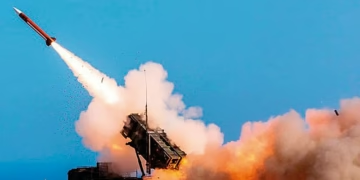
| Aerospace & Defense | Commercial satellites, spacecraft, planetary rovers, and Commerce-controlled military equipment; lifting of restrictions on unmanned aerial vehicle (UAV) programs. |
| Critical Infrastructure | High-performance dual-use technologies optimized for oil and gas production, industrial desalination plants, and civil nuclear power generation. |
| Advanced Computing | Quantum computing elements, semiconductors, next-generation telecommunications hardware, and cloud-data center infrastructure. |
A primary catalyst for the trade elevation is the U.S.-UAE Artificial Intelligence Cooperation Framework, signed in May 2025. As part of this bilateral agreement, the UAE committed to substantial reciprocal investments, including matching capital allocations dedicated to expanding AI digital infrastructure directly inside the United States.

The immediate beneficiaries of the license exemption include prominent Abu Dhabi-based technology conglomerates such as G42, Core42, and the advanced technology investment sovereign vehicle MGX. The rule also simplifies cross-border operations for major U.S. technology giants maintaining infrastructure or subsidiaries in the UAE, including Microsoft, OpenAI, Google, Oracle, Amazon, Apple, Meta, and Elon Musk’s xAI.
Saeed Al Hajeri, UAE Minister of State, stated that the U.S. decision reflects international confidence in the robustness of the Emirates’ export control and regulatory compliance systems. He added that the milestone aligns with the strategic vision of President Sheikh Mohamed bin Zayed Al Nahyan, reinforcing the country’s position as a secure global laboratory and destination for responsible technological innovation.
Beyond the immediate boost to corporate AI deployments, the regulatory ease is expected to lower operating costs and compress project timelines across the Gulf region’s energy and logistics ecosystems. By anchoring its regulatory frameworks to U.S. security standards, the UAE has secured a resilient pipeline for the foundational hardware driving the next generation of global industry.