



Crude futures plunge nearly 6% following a temporary halt in strikes, while Tehran issues a stern warning to Kyiv over a Caspian Sea ship attack.
TEHRAN/WASHINGTON — July 27, 2026 : A temporary pause in military strikes between the United States and Iran provided immediate relief to Middle East shipping corridors and energy markets on Monday, driving global oil prices down by nearly 6% as Washington indicated a willingness to give diplomatic channels space to operate.
The operational lull in exchange strikes, confirmed by diplomatic officials on both sides, follows two weeks of intense military exchanges that threatened energy shipments passing through the Strait of Hormuz. US Ambassador to the United Nations Mike Waltz stated that while American military assets remain fully prepared, President Donald Trump requested a temporary operational pause to evaluate diplomatic avenues.



Tehran confirmed that indirect communications with Washington are continuing through regional mediators, including Qatar and Pakistan. However, Iranian officials cautioned that formal negotiations require proper groundwork, accusing the United States of violating prior commitments while maintaining that defending national sovereignty remains Tehran’s immediate priority.
Energy markets reacted immediately to the cooling tensions. Global benchmark Brent crude dropped $4.89, or 5.05%, to $91.89 a barrel in early Asian trading, after surging toward multi-month highs last week. US West Texas Intermediate (WTI) fell 5.23% to $84.64 per barrel.

While the direct confrontation between Washington and Tehran showed signs of easing, a parallel diplomatic crisis emerged over the Caspian Sea. Iranian Foreign Minister Seyed Abbas Araghchi warned that a recent drone attack on an Iranian commercial vessel in the Caspian Sea “cannot go unanswered.”
Tehran directly accused Ukrainian President Volodymyr Zelensky of ordering the strike on behalf of Israel to broaden the regional conflict. The Iranian Foreign Ministry formally summoned Ukraine’s charge d’affaires in Tehran to hand over a diplomatic note of protest, while Araghchi briefed European Union Foreign Policy Chief Kaja Kallas and Russian Foreign Minister Sergei Lavrov, urging international bodies to hold those responsible accountable.
In a separate move, Iranian Deputy Foreign Minister Kazem Gharibabadi criticized Washington and Israeli Prime Minister Benjamin Netanyahu over efforts to undermine the International Criminal Court (ICC). Netanyahu had previously welcomed US commitments to oppose ICC actions after the court issued arrest warrants against top officials.
Regional Statements and Leadership Directives
Military and political maneuvers across the region remain active despite the tactical pause. Iranian Supreme Leader Mojtaba Khamenei reaffirmed Tehran’s strategic commitment to Hezbollah in a letter addressed to the Lebanese group’s leadership. Khamenei stated that securing Lebanon’s territorial integrity and achieving a complete, unconditional halt to Israeli military operations are primary requirements for any broader agreement.
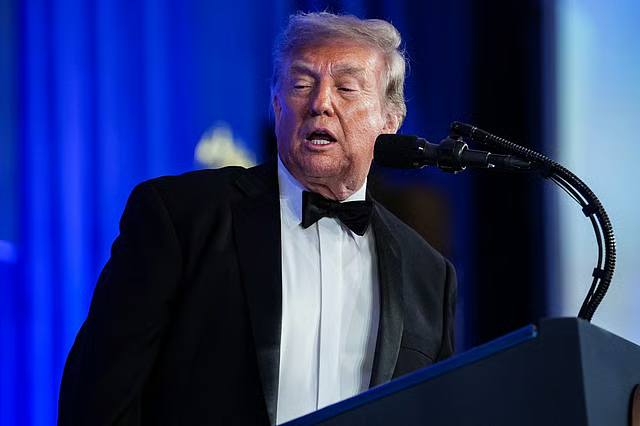
In Washington, President Trump dismissed reports suggesting that US military stocks of air defense interceptors were running low due to sustained operations in the Middle East. Trump asserted that American stockpiles remain robust, directly countering claims regarding internal military deliberations over interceptor conservation.
Israeli Prime Minister Netanyahu prepared to travel to Washington for high-level talks with President Trump, reiterating Israel’s stance that Iran’s nuclear program must be dismantled whether through a diplomatic agreement or military pressure. Netanyahu is also scheduled to attend the UN General Assembly in New York later this autumn.
Palestinian President Mahmoud Abbas appealed directly to the UN Security Council, the European Union, and the Arab League, requesting urgent international intervention to curb escalating Israeli military operations and settler violence across the occupied West Bank and East Jerusalem.