

KATHMANDU / BEIJING — August 27, 2026:
A catastrophic flash flood triggered by a massive glacial collapse high in the Himalayas has killed at least 180 people and left more than 1,300 unaccounted for across the mountain border region connecting Nepal and China’s Tibet Autonomous Region.
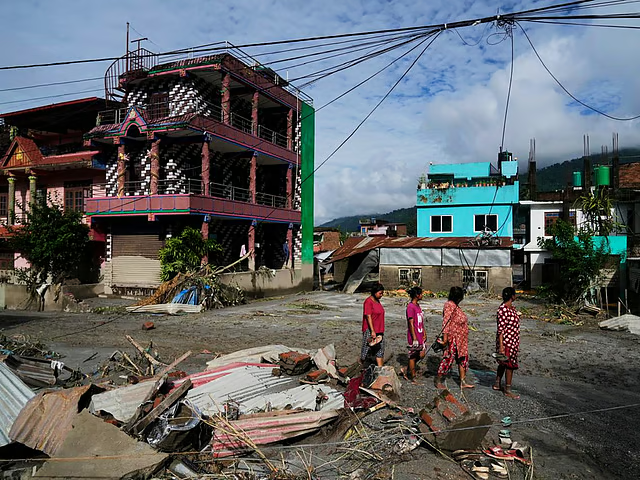
Rescue operations intensified on Thursday morning after a torrent of mud, water, and pulverized ice surged through steep river valleys, obliterating entire settlements, washing away critical highway connections, and severing communications. Authorities in Nepal confirmed at least 177 fatalities—primarily in the worst-hit districts of Rasuwa and Nuwakot—while Chinese state media confirmed three deaths and hundreds missing near Gyirong Port.


The US Geological Survey (USGS) clarified that the disaster was not caused by an earthquake, revising an initial report of a magnitude 4.4 tremor. Seismic data and satellite imagery confirmed that a portion of a glacier roughly 2,000 feet (610 metres) wide snapped off at an altitude of 17,000 feet, plunging nearly 4,000 feet into the valley floor. The sheer kinetic force of the impact pulverized the ice into a fast-moving wall of water and debris that blocked and subsequently ruptured the Lhende Khola river, sending a 9-metre surge downstream into the Trishuli and Bhotekoshi rivers within 30 minutes.
“The bottom looks like a bomb exploded—it is just deposits from the broken-up glacier,” said Daniel Shugar, a geologist at the University of Calgary who analyzed satellite imagery of the collapse site.
The wall of water struck key economic and travel corridors with virtually no warning. Infrastructure damage has hampered relief work, with at least 19 bridges and nearly 40 kilometres of highways washed away. The historic Rasuwagadhi customs post—a critical land route for cross-border trade between Nepal and China—was destroyed.

Military and private rescue helicopters were deployed at dawn to evacuate survivors cut off by washed-out roads. Nepalese Army spokesperson Brigadier General Raja Ram Basnet confirmed that teams had airlifted more than 100 people, including foreign nationals and workers trapped at the Trishuli hydropower project. Emergency workers recovered bodies as far as 100 kilometres downstream in Chitwan district.
Uncertainty remains high over the fate of hundreds of international visitors. The region was packed with foreign trekkers and Hindu pilgrims traveling to Mount Kailash in Tibet via Rasuwa district during the local Janai Purnima period. Officials in Nepal and China reported hundreds of missing foreigners, including large groups of pilgrims from India, along with travelers from Australia, the United States, the United Kingdom, Ukraine, and Malaysia.

Across the border in Tibet’s Gyirong County, Chinese emergency services deployed nearly 800 rescue personnel, heavy machinery, speedboats, and sniffer dogs. State broadcaster CCTV reported that mudslides deposited debris over 1.5 metres deep across border routes, while the formation of a temporary barrier lake upstream presents an ongoing threat of secondary flash floods.
Diplomatic coordination for relief efforts is expanding rapidly. Nepalese government spokesperson Sasmit Pokharel confirmed that official requests for humanitarian assistance were extended to neighboring India and China. Indian Prime Minister Narendra Modi held discussions with Nepal Prime Minister Balendra Shah, assuring full support and immediate relief supplies, while relief agencies under the United Nations began deploying emergency personnel to address what officials warned is a growing humanitarian crisis.
Environmental scientists emphasized that the calamity highlights heightened vulnerabilities across the rapidly warming Hindu Kush Himalaya region. Experts from the International Centre for Integrated Mountain Development noted that the Lhende River basin has suffered two severe surge events within 14 months, calling for the urgent installation of real-time early warning networks to protect vulnerable downstream communities.