


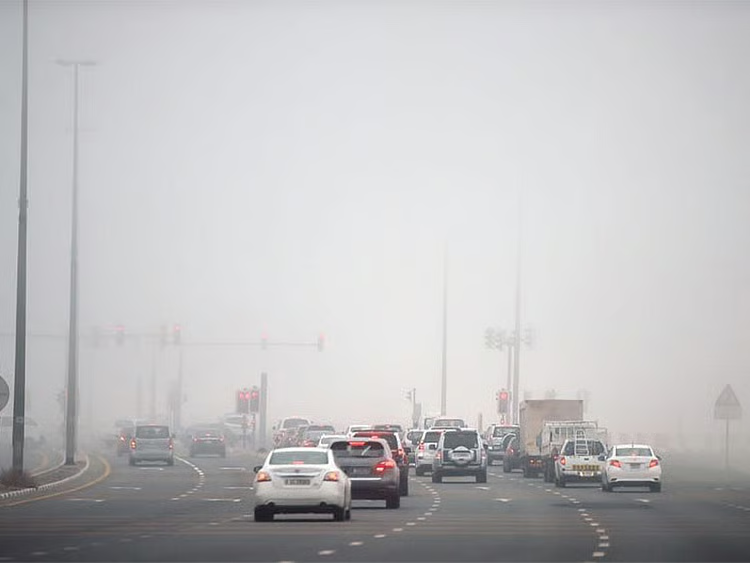
National Centre of Meteorology issues early warnings for inland corridors and coastal roads as radiation fog season begins
DUBAI — September 2, 2026 : Thick early morning fog and mist have begun rolling across parts of the United Arab Emirates, prompting weather authorities to issue visibility alerts as high seasonal humidity combines with cooler desert nights.
The National Centre of Meteorology (NCM) issued a yellow and red fog advisory covering the early morning hours of Wednesday, warning that horizontal visibility drops drastically across interior highways and low-lying coastal strips. While daytime temperatures still sit in the low-to-mid 40s Celsius, overnight relative humidity levels are climbing to roughly 90 per cent, setting off the atmospheric conditions that produce the country’s annual fog season.

The current weather pattern marks the practical arrival of radiation fog, which accounts for roughly 95 per cent of all fog recorded across the Emirates. The phenomenon occurs when warm, moisture-laden breezes sweep inland from the Arabian Gulf during late afternoon. As night falls, the open desert rapidly radiates its heat back into space. The air directly above the cooling sand cools to its dew point, condensing suspended water vapour around fine desert dust particles. Light winds under five knots help the moist layer settle into dense blankets across transit corridors.


This seasonal shift corresponds with the rise of the Suhail star (Canopus), observed on August 24, which traditionally marks the end of extreme summer heat and the onset of elevated humidity and morning dew across the Arabian Peninsula.
Geography plays a direct role in where drivers encounter the thickest banks. Studies by Khalifa University’s Environmental and Geophysical Sciences Lab point to the Sweihan desert and regions southwest of Abu Dhabi as primary formation pockets. Open desert freeways—particularly the Abu Dhabi–Dubai route, the Abu Dhabi–Al Ain highway, the Mleiha artery, and secondary links running through Al Dhafra—consistently face the sharpest drops in visibility.
Police commands across Abu Dhabi, Dubai, and Sharjah have urged motorists to adjust morning routines. Abu Dhabi’s automated system activates variable speed limits, dropping maximum highway speeds to 80 km/h when visibility falls below critical thresholds.

Drivers navigating foggy corridors are instructed to engage low-beam headlights rather than emergency hazard flashers, avoid the high-speed far-left lane, refrain from overtaking, and maintain wide trailing distances. Motorists unable to navigate safely should pull entirely off the highway rather than stopping on road shoulders.
Meteorologists forecast similar conditions through early autumn. As overnight temperatures gradually dip while coastal waters remain hot, rapid dew-point convergence will make pre-dawn fog alerts a routine fixture across UAE highways through February.