

Saudi civil aviation authorities confirm multinational casualties after a missile and drone strike halted flights at the capital’s main international hub
RIYADH, Oct. 11, 2026 :A deadly strike on King Khalid International Airport in Riyadh killed 12 people and injured 309 others on Saturday afternoon, marking the single deadliest assault on civilian aviation infrastructure in Saudi Arabia in recent years.

Saudi Arabia’s General Authority of Civil Aviation (GACA) confirmed the casualty toll early Sunday following comprehensive hospital admissions across the capital. The victims killed in the blast represent multiple nationalities, underscoring the international transit footprint of the hub. Four Saudi nationals died alongside two Bangladeshi citizens and one national each from the United States, Egypt, Jordan, Syria, Palestine, and Sudan.
Emergency response teams transferred 309 injured people to specialized facilities across Riyadh. Health officials noted that several patients remain in critical condition with severe trauma and blast injuries.


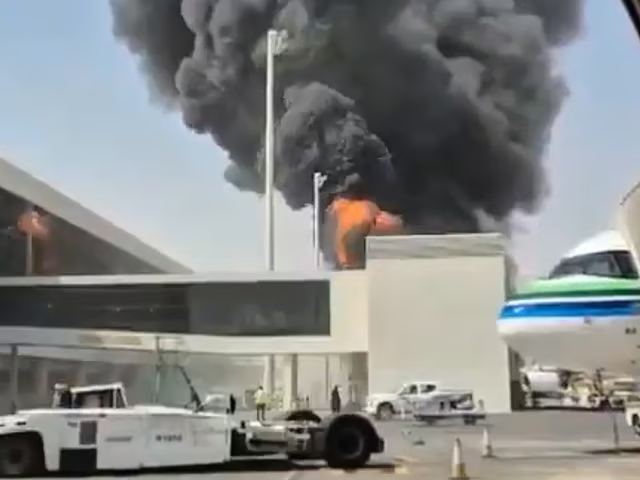
The attack struck during a busy travel window on Saturday afternoon, puncturing a departure concourse, shattering glass, and causing portions of a ceiling to collapse near passenger gates. Eyewitnesses reported hearing multiple explosions before heavy black smoke billowed from terminal structures. Flight tracking services showed immediate diversions and ground halts across all incoming traffic as air controllers routed incoming planes to secondary hubs in Dammam, Jeddah, and Medina.

Yemen’s Houthi movement asserted responsibility for targeting the airport, issuing public warnings to international carriers to avoid Saudi airspace. The strike follows days of escalating skirmishes along the Red Sea coast after Saudi-backed Yemeni government forces attempted to dislodge Houthi positions around the Bab el-Mandeb strait. An earlier wave of strikes on Thursday had already damaged ground facilities and an empty passenger jet operated by national carrier Saudia.
GACA announced that flight operations were temporarily suspended while bomb disposal units, structural engineers, and forensic teams conducted perimeter sweeps and structural assessments. Authorities began a gradual reopening of auxiliary runways and operational sectors late Saturday once fire crews extinguished flare-ups in peripheral maintenance zones.
Diplomatic missions in Riyadh reacted swiftly. The U.S. Embassy urged American citizens to steer clear of the airport perimeter and adhere to local emergency alerts. In Washington, U.S. Secretary of State Marco Rubio condemned the strike as an unprovoked assault on civilians, while President Donald Trump indicated his administration is reviewing intelligence before deciding whether to expand joint operations alongside Saudi air defense forces.
Technical teams are completing debris removal inside the damaged terminal sections to prepare the facility for scheduled international traffic ahead of several high-profile regional conferences slated for Riyadh this month.