


Washington prepares swift military evaluation as Saudi aviation authority reports 12 dead and over 300 injured in the kingdom’s worst air hub assault
WASHINGTON / RIYADH — October 11, 2026 :United States President Donald Trump said the White House is actively weighing direct military strikes alongside Saudi Arabia against Yemen’s Houthi forces following a devastating missile assault on Riyadh’s King Khalid International Airport that killed at least 12 people and wounded more than 300.
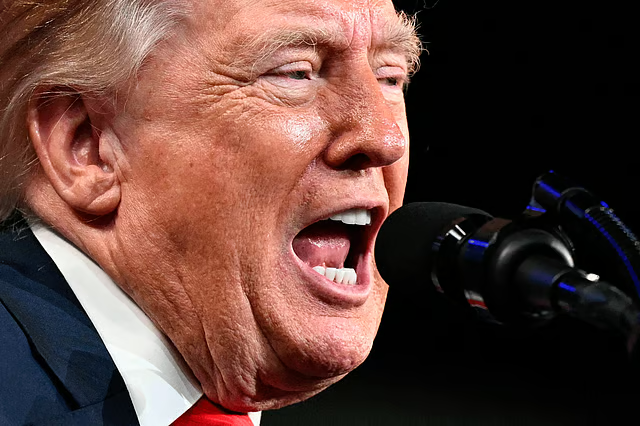
Speaking to reporters outside the White House before departing for an event in Tennessee, Trump confirmed that senior defense officials are reviewing options to intervene directly against the Yemeni group.
“We may. We’re going to look at it,” Trump said. “We just found out about the recent attack. So we’ll make a decision. We move very quickly.”



The Saturday assault paralyzed Saudi Arabia’s busiest civilian aviation hub, grounding flights across the capital and scattering debris across domestic and international concourses. Saudi civil aviation officials confirmed that 12 people were killed and 309 injured, including an American citizen and multiple foreign nationals, marking the deadliest single attack on Gulf soil since regional fighting intensified.

US Secretary of State Marco Rubio denounced the strike as reprehensible, stating that aerial attacks against civilian aviation hubs must cease immediately.
The incident follows a string of strikes across Saudi territory over the past week. Earlier operations claimed by the Houthis struck Riyadh and southern facilities in Abha, killing three Saudi citizens including a commercial pilot for flag carrier Saudia. In response, Saudi-led coalition aircraft carried out widespread retaliatory raids, claiming the destruction of more than 130 Houthi targets across northern Yemen.
While the Pentagon already provides intelligence sharing, aerial surveillance, and targeting coordination to the Saudi military, direct kinetic action would represent a sharp escalation of American involvement. Washington conducted an eight-week sustained naval and aerial bombing campaign against Houthi coastal batteries, radar stations, and drone depots, but the group managed to reconstitute its long-range missile and drone stockpiles.
Strategic stakes have surged around the Bab al-Mandab Strait, where pro-government southern Yemeni brigades, backed by Riyadh, launched a coordinated push to dislodge Houthi units controlling coastal vantage points and islands overlooking the Red Sea. With shipping through the Suez Canal already compressed and the Strait of Hormuz subject to heightened security risks, disruptions around Bab al-Mandab threaten global maritime supply lines and crude oil transport.
European aviation regulators have urged commercial carriers to exercise extreme caution in Saudi airspace. Meanwhile, regional diplomats from Saudi Arabia and Oman continue quiet backchannel discussions to arrest the cycle of strikes before American forces enter the theater of direct confrontation.