

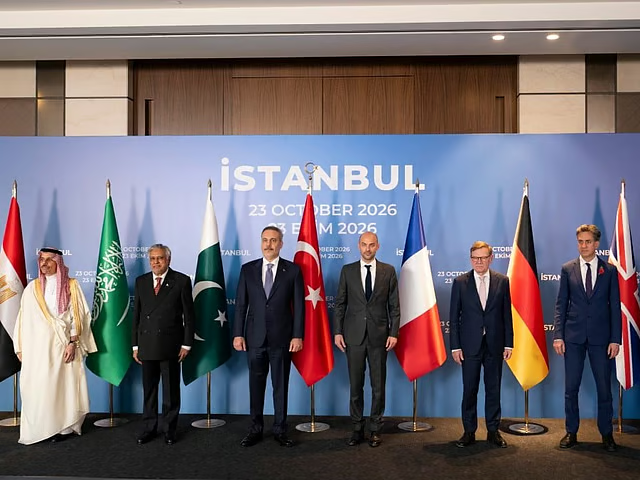
Foreign ministers from Britain, France, Germany, Italy, Turkey, Saudi Arabia, Egypt, and Pakistan align on maritime chokepoints and regional de-escalation.
ISTANBUL, Oct 24 :Top diplomats from four major European powers and four regional heavyweights gathered in Istanbul to confront mounting threats to global shipping routes, focusing on the Strait of Hormuz, the Bab al-Mandab, and cross-border missile strikes impacting Saudi Arabia.
The unprecedented gathering brought together the European “E3” nations—Britain, France, and Germany—alongside Italy, to sit down with foreign ministers from Turkey, Saudi Arabia, Egypt, and Pakistan. Turkish Foreign Minister Hakan Fidan convened the high-level dialogue at a hotel overlooking the Bosphorus, following a series of bilateral coordination sessions.


Maritime trade lanes dominated the agenda. Officials addressed escalating disruption across key maritime bottlenecks including the Strait of Hormuz, the Bab al-Mandab, and the Suez Canal. Diplomatic sources confirmed the talks centered on coordinating naval security, preventing maritime blockades from choking energy markets, and establishing immediate diplomatic channels to defuse Gulf waters.
British Foreign Secretary David Lammy’s delegation stressed that restoring full freedom of navigation through the Strait of Hormuz remains non-negotiable for international commerce. British delegates noted that cross-border aerial assaults on Saudi Arabian territory risk triggering systemic disruption across vital maritime transit corridors, urging collective deterrence alongside diplomatic engagement.
France framed the session as an essential, overdue framework bridging Europe and the Middle East during acute geopolitical strain. French foreign ministry officials underscored the necessity of direct coordination, pointing out that instability across Red Sea shipping lanes imposes immediate economic and logistical penalties on both continents.

Security guarantees for Saudi critical infrastructure featured heavily throughout the discussions. Houthi strikes targeting Saudi territory have disrupted civil aviation and delayed major economic forums, prompting Western allies to shore up defense commitments. Paris has committed naval and technical assistance to safeguard Red Sea logistics nodes, including the oil terminal at Yanbu, while London dispatched fighter aircraft to support air-defense interception networks over the kingdom.

Turkish Foreign Minister Hakan Fidan pressed for durable, regionally driven solutions. Fidan argued that security frameworks imposed exclusively by external actors rarely yield lasting stability. Ankara’s stance, he said, emphasizes regional ownership: local powers must assume operational responsibility for keeping commercial transit corridors open and preventing disparate conflicts from merging into broader warfare.
Turkish delegates raised concerns over rising tensions across the Palestinian territories, demanding greater international scrutiny on settlement activity in the West Bank. Regional security concerns in the Black Sea and the wider fallout of the Russia-Ukraine war were also presented, with Ankara warning against maritime conflict expanding into commercial trade routes.
Egypt, balancing its regional commitments, affirmed its pledge to defend Saudi sovereignty while maintaining that Cairo will not participate in offensive operations inside Yemen. The diplomatic forum concluded with all eight delegations agreeing to preserve backchannel consultations on maritime defense and commercial corridor preservation.