


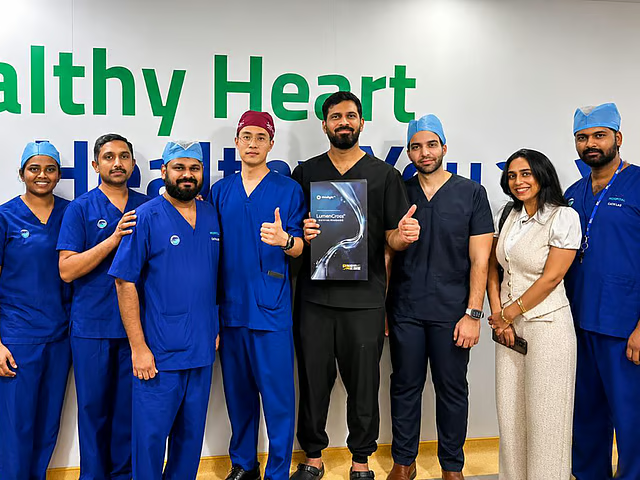
The UAE facility becomes the first medical center in the Gulf region to deploy Vivolight’s Cornaris P80 system, enabling real-time intra-arterial imaging during coronary procedures.
DUBAI — Aster Hospital Mankhool has integrated a next-generation heart imaging platform into its interventional cardiology unit, becoming the first facility in the Gulf Cooperation Council (GCC) to adopt the technology for complex coronary procedures.
The hospital deployed the Cornaris P80/P80-E Optical Coherence Tomography (OCT) platform, manufactured by medical device developer Vivolight, during a percutaneous coronary intervention (PCI). The high-resolution system allows interventional cardiologists to capture detailed, cross-sectional views from inside cardiac blood vessels in real time.

Standard fluoroscopic angiography produces two-dimensional shadows of blood vessels using X-rays. In contrast, the newly introduced OCT system uses near-infrared light to construct high-definition images of vessel walls. The platform enables clinical teams to evaluate the composition of arterial blockages, quantify calcium deposits, and measure vessel dimensions prior to placing stents or balloons.



The clinical implementation was led by Dr. Naveed Ahmed, Head of Cardiac Services at Aster Hospitals & Clinics UAE.
“Instead of relying only on traditional images, we can now assess the structure of the blockage and the surrounding artery in much greater detail,” Dr. Ahmed said. “This helps us perform complex procedures with greater precision and make better treatment decisions for our patients.”
The initial procedure utilizing the Cornaris P80 platform involved a 52-year-old male resident of Dubai presenting with non-ST-elevation myocardial infarction (NSTEMI), a form of acute coronary syndrome. The patient presented with underlying comorbidities, including type 2 diabetes, hypertension, and hyperlipidemia.
Diagnostic evaluation revealed severe luminal narrowing within a primary coronary artery alongside secondary disease in an adjacent segment. Using OCT guidance, the medical team performed a multi-stage intervention that included the deployment of a drug-eluting stent (DES) combined with a drug-coated balloon (DCB) angioplasty.
The procedure was performed on June 2, 2026, successfully restoring vessel patency and coronary blood flow. The patient was discharged the following day without post-procedural complications and has remained asymptomatic during follow-up evaluations.
Coronary artery disease continues to represent a major cause of morbidity and mortality across the Arabian Gulf region. Traditional PCI relies heavily on visual estimates, which can lead to sub-optimal stent expansion or malapposition against the arterial wall.
“Introducing the technology reflects the hospital’s commitment to bringing proven medical innovations to patients in the region,” said Dr. Sherbaz Bichu, Chief Executive Officer of Aster Hospitals & Clinics for the UAE, Oman, and Bahrain. “The system enables specialists to capture detailed artery scans within seconds, improving the management of complex heart conditions and supporting better patient outcomes.”
The Cornaris platform executes full-length vessel pullbacks in one to three seconds, minimizing the volume of radiopaque contrast dye required during the scan. Clinical trials comparing intravascular imaging modalities indicate that OCT-guided PCI reduces major adverse cardiac events (MACE), stent thrombosis, and cardiac mortality compared to angiography alone.
Aster Hospital Mankhool was ranked fourth among UAE healthcare institutions in Newsweek’s World’s Best Hospitals 2026 index. The introduction of intra-coronary optical imaging forms part of the group’s wider effort to expand specialized tertiary care offerings across its Gulf network.