

SpaceX chief accuses Reliance chairman of monopolistic control as New Delhi refutes bias, stating all satellite internet applicants face identical security reviews.
NEW DELHI —Elon Musk has sharply escalated his campaign against regulatory delays blocking SpaceX’s Starlink in India, sarcastically addressing billionaire industrialist Mukesh Ambani as “Prime Minister Ambani” and accusing domestic conglomerates of maintaining a monopolistic chokehold over digital connectivity.

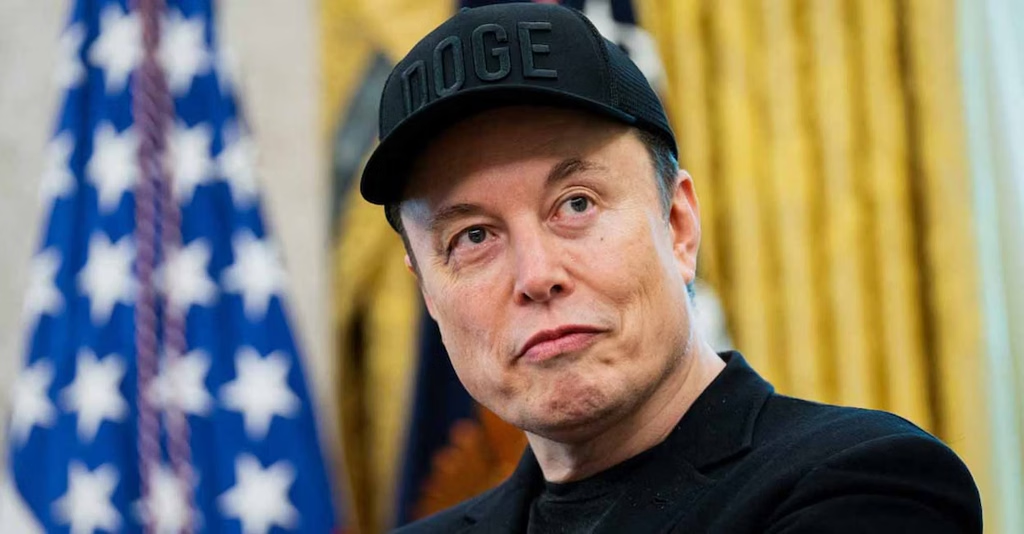
Musk posted the pointed critique on social media platform X after Indian authorities dismissed his previous suggestions of administrative favouritism as baseless.
“Dear Prime Minister Ambani, Please accept my humble apologies for not realizing that you are the real boss of India,” Musk wrote. He went on to allege that Ambani’s commercial interests were keeping Starlink out to preserve market dominance, asking whether the Reliance chairman would allow foreign satellite competition to bring reliable broadband to rural and remote regions.


The dispute strikes at the core of India’s emerging satellite communications (satcom) sector, an arena where traditional telecom networks struggle to reach geographically challenging terrain. Musk argued that Starlink holds commercial licences in more than 165 countries and has worked for five years to adhere to Indian regulatory conditions, only to remain stalled without operational clearance.
India’s Ministry of Communications pushed back against the accusations. In an official statement, the ministry maintained that India operates an entirely uniform, transparent, and non-discriminatory framework across all telecommunications services. Union Telecom Minister Jyotiraditya Scindia stated that India does not permit monopolies in any industry and underscored that compliance with statutory security standards is non-negotiable for all operators.
According to the Department of Telecommunications, three primary entities have received satcom licences: Musk’s Starlink, Reliance’s Jio Satellite Communications, and Bharti-backed Eutelsat OneWeb. None of the three can initiate commercial transmission until completing mandatory Ministry of Home Affairs security vetting and receiving definitive spectrum assignments.
Minister of State for Communications Chandra Sekhar Pemmasani clarified that provisional clearances have been extended equally and the pending security evaluations apply uniformly across all applicants. Sunil Bharti Mittal, chairman of Bharti Enterprises, also noted that his OneWeb venture continues to await its own final regulatory clearances.
When asked about Musk’s comments on the sidelines of the India Mobile Congress in New Delhi, Reliance Jio Infocomm Chairman Akash Ambani declined to engage in the public spat. “No comments. We want to be heads down and deliver value to our Indian consumers,” he said, adding that Jio is advancing its proprietary satellite stack.
The confrontation has also sparked domestic political discussion. Leader of the Opposition Rahul Gandhi responded to Musk’s initial criticisms of Indian oligarchs with the remark: “Welcome to India, Elon. Wait till you discover the other guy,” an apparent reference to industrialist Gautam Adani. Gandhi called for an economy anchored in innovation rather than political patronage, while Musk termed the dynamic “troubling”.

SpaceX maintains that satellite connectivity would offer essential lifelines to underserved Indian schools, healthcare centers, and small rural businesses. New Delhi, however, appears unwilling to bypass its strict domestic data-routing and national security verification protocols to expedite Starlink’s debut.