


Public health specialists in Dubai examine Sweden’s dual strategy of strict tobacco control and smoke-free alternatives as a blueprint for cutting regional smoking rates
DUBAI : Sweden has cut its daily smoking rate to 3.7%, effectively becoming the first European country to achieve smoke-free status years ahead of continental targets, offering regional health specialists meeting in Dubai an evidence-based roadmap to accelerate tobacco harm reduction across the Middle East.
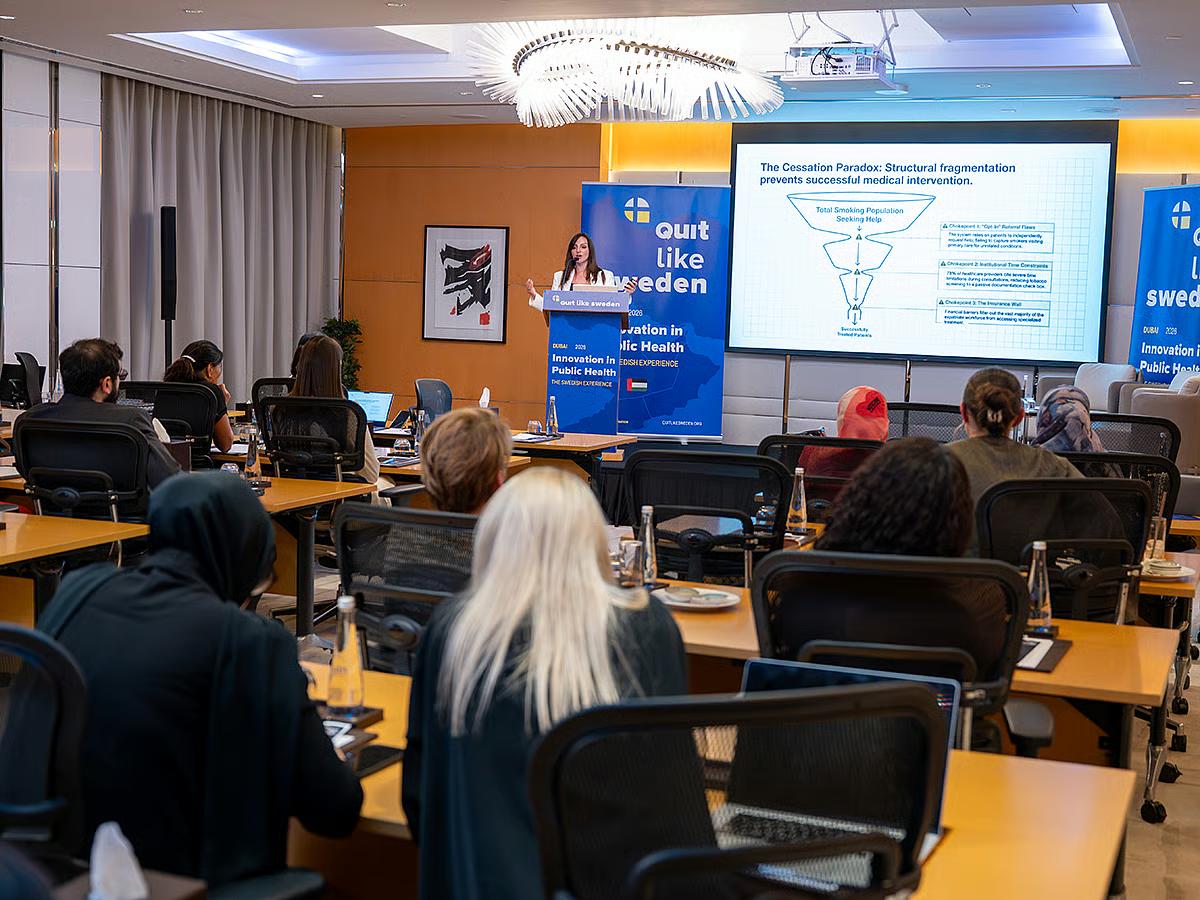
The Swedish model—combining traditional tobacco prevention measures with regulated, smoke-free alternatives—took center stage at the “Innovation in Public Health: The Swedish Experience” symposium hosted by independent initiative Quit Like Sweden (QLS) at Hilton Dubai Palm Jumeirah.


The European Union defines a country as “smoke-free” once daily cigarette smoking drops below 5%. While the bloc has set a 2040 deadline to reach that benchmark, Sweden crossed it 16 years early.
Public health advocates attribute this shift to a deliberate strategy rather than prohibition alone. Sweden adopted World Health Organization (WHO) tobacco control recommendations while simultaneously permitting reduced-risk nicotine delivery products for adult smokers unable or unwilling to quit cold turkey.
Central to the model is the “Three As” framework: alternatives must be accessible, acceptable in meeting adult taste and habit preferences, and affordable compared to combustible cigarettes. When alternative products face excessive taxation or bureaucratic barriers, health researchers noted, combustible cigarettes remain the path of least resistance.
For the UAE, the lessons arrive amid active regulatory reform. Federal authorities introduced formal standards for electronic nicotine delivery systems in 2019, followed by regulations governing nicotine pouches in 2025 for adults aged 18 and older.
With expatriates comprising nearly 90% of the UAE’s resident population, tobacco consumption patterns vary widely across demographics, often reflecting habits carried over from home countries—including traditional smokeless products such as nasvay and betel quid.
Swedish migration data illustrates how regulatory environments reshape behaviour: European immigrants moving to Sweden record a smoking rate of 7.8%, sharply down from the 24% average seen in their countries of origin.
Frontline medical practitioners in Dubai point to structural hurdles currently complicating patient cessation efforts.
“Every week I see people whose lungs are showing the damage from smoking much earlier in life than they should,” said Dr. Rachel Kaminski, a physician at Saudi German Hospital. “Many of them want to stop and have tried more than once. What they lack is proper support: dedicated cessation services, treatment covered by insurance, and something realistic to offer those who cannot quit. Without that, we are treating the consequences, not the cause.”

Misconceptions around regional tobacco habits also dilute harm-reduction strategies. Dr. Mohammad Fawzi Katranji, a consultant pulmonologist, pointed out that regional users frequently consider shisha or midwakh healthier than factory cigarettes, even though both burn leaf tobacco. Dokha used in midwakh can deliver five times the nicotine and approximately 55% more tar than a standard cigarette, while a single continuous shisha session can equal the smoke volume of 40 or more cigarettes.
Addressing technical concerns raised around non-combustible products, clinicians untangled common points of public confusion. Dr. Garrett McGovern, a Dublin-based addiction medicine specialist, addressed clinical queries on lung ailments, explaining that the 2019 EVALI outbreak in the United States stemmed from black-market THC vaping cartridges laced with toxic vitamin E acetate, rather than legally regulated nicotine e-liquids. McGovern added that there remains no established clinical evidence linking regulated nicotine vaping to bronchiolitis obliterans, commonly termed “popcorn lung,” a condition originally tied to industrial-scale inhalation of diacetyl in manufacturing plants.
Specialists also reiterated the foundational toxicology principle framed half a century ago by British researcher Professor Michael Russell: while nicotine drives physical dependence, combustible tar, carbon monoxide, and toxic combustion by-products cause cardiovascular and respiratory disease. Nicotine itself remains listed on the WHO Model List of Essential Medicines in the form of replacement therapies, and several smoke-free products have obtained marketing authorizations from the US Food and Drug Administration (FDA) under its public health protection standards.
Clinical discussions also highlighted disproportionately vulnerable demographics, such as individuals undergoing recovery from substance abuse or managing psychiatric conditions.
“People living with mental health disorders are significantly more likely to smoke, often smoke more heavily and are less likely to quit successfully, contributing to disproportionately high rates of smoking-related disease and premature death,” Dr. McGovern observed.
Product innovation within Sweden historically targeted distinct user segments. Traditional oral snus gained widespread traction among Swedish men, while newer, tobacco-free white nicotine pouches achieved wider adoption among women seeking an exit from cigarettes, according to Beatriz Santos, Chief Commercial Officer at global advocacy network We Are Innovation.
“Behind every smoking statistic is a person, a family and a community affected by smoking-related disease,” said Suely Castro, founder of Quit Like Sweden. “What we heard in Dubai reinforces the importance of giving adults who smoke better choices and ensuring that lower-risk alternatives are accessible, acceptable and affordable. Sweden has shown what is possible. The challenge now is to translate those lessons into approaches that work for the UAE and the wider region.”
Public health specialists in Dubai examine Sweden’s dual strategy of strict tobacco control and smoke-free alternatives as a blueprint for cutting regional smoking rates
DUBAI : Sweden has cut its daily smoking rate to 3.7%, effectively becoming the first European country to achieve smoke-free status years ahead of continental targets, offering regional health specialists meeting in Dubai an evidence-based roadmap to accelerate tobacco harm reduction across the Middle East.
The Swedish model—combining traditional tobacco prevention measures with regulated, smoke-free alternatives—took center stage at the “Innovation in Public Health: The Swedish Experience” symposium hosted by independent initiative Quit Like Sweden (QLS) at Hilton Dubai Palm Jumeirah.
The European Union defines a country as “smoke-free” once daily cigarette smoking drops below 5%. While the bloc has set a 2040 deadline to reach that benchmark, Sweden crossed it 16 years early.
Public health advocates attribute this shift to a deliberate strategy rather than prohibition alone. Sweden adopted World Health Organization (WHO) tobacco control recommendations while simultaneously permitting reduced-risk nicotine delivery products for adult smokers unable or unwilling to quit cold turkey.
Central to the model is the “Three As” framework: alternatives must be accessible, acceptable in meeting adult taste and habit preferences, and affordable compared to combustible cigarettes. When alternative products face excessive taxation or bureaucratic barriers, health researchers noted, combustible cigarettes remain the path of least resistance.

For the UAE, the lessons arrive amid active regulatory reform. Federal authorities introduced formal standards for electronic nicotine delivery systems in 2019, followed by regulations governing nicotine pouches in 2025 for adults aged 18 and older.
With expatriates comprising nearly 90% of the UAE’s resident population, tobacco consumption patterns vary widely across demographics, often reflecting habits carried over from home countries—including traditional smokeless products such as nasvay and betel quid.
Swedish migration data illustrates how regulatory environments reshape behaviour: European immigrants moving to Sweden record a smoking rate of 7.8%, sharply down from the 24% average seen in their countries of origin.
Frontline medical practitioners in Dubai point to structural hurdles currently complicating patient cessation efforts.
“Every week I see people whose lungs are showing the damage from smoking much earlier in life than they should,” said Dr. Rachel Kaminski, a physician at Saudi German Hospital. “Many of them want to stop and have tried more than once. What they lack is proper support: dedicated cessation services, treatment covered by insurance, and something realistic to offer those who cannot quit. Without that, we are treating the consequences, not the cause.”
Misconceptions around regional tobacco habits also dilute harm-reduction strategies. Dr. Mohammad Fawzi Katranji, a consultant pulmonologist, pointed out that regional users frequently consider shisha or midwakh healthier than factory cigarettes, even though both burn leaf tobacco. Dokha used in midwakh can deliver five times the nicotine and approximately 55% more tar than a standard cigarette, while a single continuous shisha session can equal the smoke volume of 40 or more cigarettes.
Addressing technical concerns raised around non-combustible products, clinicians untangled common points of public confusion. Dr. Garrett McGovern, a Dublin-based addiction medicine specialist, addressed clinical queries on lung ailments, explaining that the 2019 EVALI outbreak in the United States stemmed from black-market THC vaping cartridges laced with toxic vitamin E acetate, rather than legally regulated nicotine e-liquids. McGovern added that there remains no established clinical evidence linking regulated nicotine vaping to bronchiolitis obliterans, commonly termed “popcorn lung,” a condition originally tied to industrial-scale inhalation of diacetyl in manufacturing plants.
Specialists also reiterated the foundational toxicology principle framed half a century ago by British researcher Professor Michael Russell: while nicotine drives physical dependence, combustible tar, carbon monoxide, and toxic combustion by-products cause cardiovascular and respiratory disease. Nicotine itself remains listed on the WHO Model List of Essential Medicines in the form of replacement therapies, and several smoke-free products have obtained marketing authorizations from the US Food and Drug Administration (FDA) under its public health protection standards.
Clinical discussions also highlighted disproportionately vulnerable demographics, such as individuals undergoing recovery from substance abuse or managing psychiatric conditions.
“People living with mental health disorders are significantly more likely to smoke, often smoke more heavily and are less likely to quit successfully, contributing to disproportionately high rates of smoking-related disease and premature death,” Dr. McGovern observed.
Product innovation within Sweden historically targeted distinct user segments. Traditional oral snus gained widespread traction among Swedish men, while newer, tobacco-free white nicotine pouches achieved wider adoption among women seeking an exit from cigarettes, according to Beatriz Santos, Chief Commercial Officer at global advocacy network We Are Innovation.
“Behind every smoking statistic is a person, a family and a community affected by smoking-related disease,” said Suely Castro, founder of Quit Like Sweden. “What we heard in Dubai reinforces the importance of giving adults who smoke better choices and ensuring that lower-risk alternatives are accessible, acceptable and affordable. Sweden has shown what is possible. The challenge now is to translate those lessons into approaches that work for the UAE and the wider region.”