

Humanoid robots undergo rigorous vocational training in Hangzhou across simulated mines, kitchens, and farms to bridge the gap between lab tests and everyday labor.
HANGZHOU, China : In a specialized facility in eastern China, dozens of “students” are spending eight-hour days drilling repetitive physical tasks. They do not take coffee breaks, attend lectures, or sit for written exams. Instead, human trainers equipped with motion-capture suits and remote controllers guide these humanoid robots through real-world job scenarios.

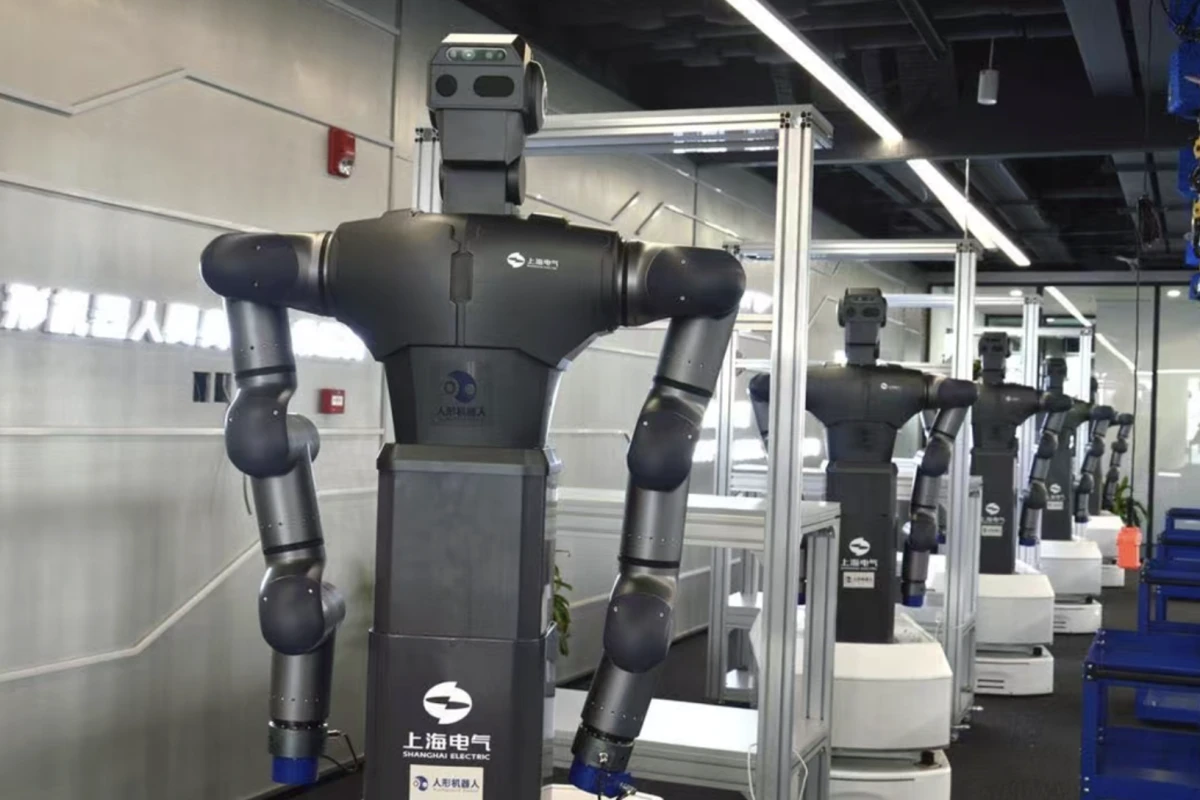
Known as the National Pilot Base for Embodied AI Applications, the site in Hangzhou, Zhejiang Province, functions as the world’s first national-level vocational training facility for humanoid robots. More than 140 robots built by nearly 40 technology firms and academic institutions are undergoing intensive instruction across 40 simulated environments, ranging from dimly lit mine shafts to commercial kitchens and agricultural fields.
While humanoid machines have frequently drawn public attention for performing backflips or dancing at trade shows, commercial adoption has lagged due to difficulty handling unpredictable physical environments. The Hangzhou facility was designed specifically to overcome this gap by collecting massive datasets of physical interactions.


The facility operates on a dual-track training system. In physical environments, technicians operate humanoids through specific tasks repeatedly. Sensors capture every subtle angle, pressure point, and movement, generating raw data that feeds into foundational artificial intelligence models. Human operators also wear data gloves to record precise movements, mapping physical human dexterousness directly onto mechanical frames. Simultaneously, high-fidelity virtual simulations allow thousands of digital iterations to run every hour.
In a mock restaurant unit, humanoids learn complete kitchen workflows, including taking orders, fetching raw ingredients, stir-frying dishes within four minutes, plating meals, and clearing tables. In other zones, machines practice precision industrial assembly, warehouse sorting, and basic agricultural tasks.

The initiative aligns with broader Chinese industrial policy. In June, the Ministry of Industry and Information Technology along with the State-owned Assets Supervision and Administration Commission announced a joint national strategy to accelerate real-scenario training and deployment of embodied AI products. Hangzhou alone hosts over 700 robotics firms, forming an industrial cluster that generated 106.8 billion yuan ($15 billion) in output in 2025.
Developers say the shared facility substantially reduces research and development costs by providing ready-made testing environments, allowing startups to run feasibility tests without building expensive physical setups. Once models pass certification, they will be deployed in designated trial communities for further real-world evaluation.