

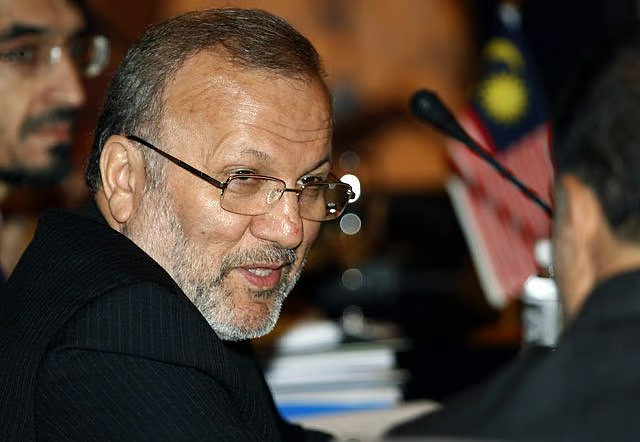
Former Foreign Minister Manouchehr Mottaki claims capturing a single American installation would seal the outcome of hostilities as diplomatic talks remain stalled.
TEHRAN:Former Iranian Foreign Minister and current member of parliament Manouchehr Mottaki has claimed that capturing a single U.S. military installation in the region would decisively end Tehran’s conflict with Washington.
Speaking at an event covered by Iranian news outlets, including the Student News Network (SNN), Mottaki declared that seizing an American base would resolve the military confrontation against what he characterized as the world’s largest imperialist army. Video footage of the remarks circulated widely across social media platforms.
The statements reflect ongoing hardline rhetoric within Iran’s Majles following months of cross-border military exchanges. Mottaki, who led Iran’s Foreign Ministry from 2005 to 2010 under former President Mahmoud Ahmadinejad and currently represents Tehran in parliament, has previously advocated for ground operations against American positions in the region.



In television appearances earlier this year, Mottaki suggested that Iranian forces could conduct ground assaults against American military installations in neighboring countries, proposing the capture of U.S. military personnel to use as leverage. He also called for broader regional measures, urging Tehran to designate several regional nations hosting American infrastructure as hostile targets.

The former diplomat framed his proposals as responses to coalition strikes against Iranian positions and infrastructure. However, government officials in Tehran have not publicly announced any operational plans matching the scale of a ground assault or base seizure.
Military analysts note that any attempt to launch a ground attack against U.S. military installations in the region would encounter severe logistical and tactical barriers. The U.S. maintains significant air superiority, surveillance systems, and rapid-response capabilities across its Gulf facilities, including naval and air bases in Bahrain, Kuwait, Qatar, and Iraq.
The rhetoric coincides with heightened diplomatic friction after a temporary 60-day understanding between Washington and Tehran lapsed without yielding a permanent ceasefire or resolving maritime security issues surrounding the Strait of Hormuz. While diplomatic channels remain open through international mediators, negotiations have stalled amid allegations of ceasefire violations and continued strikes.