

Following the collapse of a fragile truce, heavy military exchanges ignite fears of a wider war, causing oil prices to surge and regional shipping to plummet.
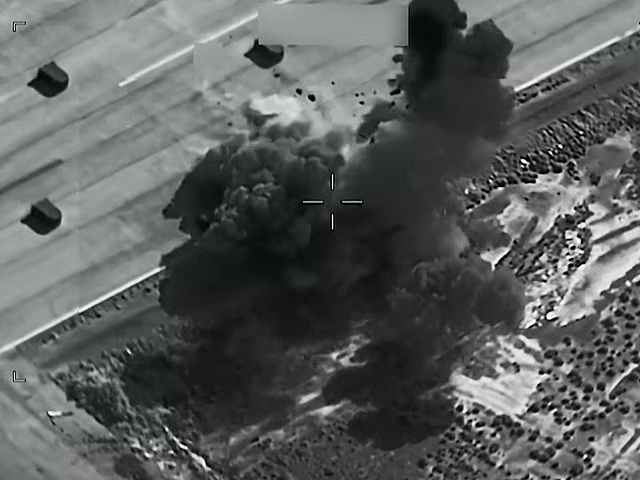
DUBAI — A massive military escalation has plunged the Middle East into deep uncertainty after the United States launched widespread airstrikes across Iran, prompting immediate retaliatory missile and drone attacks by Tehran against American bases and allied nations across the Persian Gulf.

The United States Central Command (CENTCOM) confirmed it hit approximately 90 military targets inside Iran, specifically targeting air defense systems, missile and drone storage units, and maritime infrastructure. The Pentagon described the operation as a direct response to Iranian attacks on commercial oil tankers in the Strait of Hormuz, an essential global energy chokepoint. US President Donald Trump issued a stern warning, stating that military operations would intensify significantly if threat levels to international shipping continue.



Iranian state media reported strikes spanning multiple southern and southeastern provinces, including the oceanic port city of Chabahar, Konarak, Bandar Abbas, and Iranshahr. Widespread power outages and infrastructure damage were reported. According to the Iranian Health Ministry, the two-day bombardment has left at least 14 people dead and 78 others injured. Reports also indicated explosions targeting the perimeter of the Bushehr civilian nuclear facility and vital transportation links, including railway lines leading to the holy city of Mashhad, where millions have gathered for the final burial ceremonies of the late Supreme Leader Ayatollah Ali Khamenei.
In swift retaliation, the Islamic Revolutionary Guard Corps (IRGC) launched heavy drone and missile strikes targeting US military installations, including Camp Arifjan and Ali Al Salem air base in Kuwait, alongside naval facilities in Bahrain. Air defense networks across the region were activated, with Kuwait neutralizing multiple ballistic and cruise missiles. Jordan’s armed forces also reported intercepting eight Iranian projectiles that breached its airspace. The attacks drew fierce condemnation from regional bodies, including the UAE and the Arab Parliament, which slammed the escalation as a flagrant violation of national sovereignty.
Amid the military crossfire, Israel signaled its readiness to intervene. Defence Minister Israel Katz announced that the military remains on high alert to execute a “third campaign” against Iranian targets with greater force if necessary to eliminate pressing threats. Simultaneously, the International Monetary Fund (IMF) downgraded its 2026 global economic growth forecast to 3.0 percent, explicitly warning that the reignited conflict poses severe systemic risks to global supply chains and energy stability, as Brent crude surged over 5 percent to surpass $78 a barrel.