

Trilateral alliance activates collective defense commitments following strikes on Saudi territory, while Washington eases diesel fuel curbs amid wider Iran conflict.
RIYADH, Oct. 6, 2026 :Pakistan and Turkey have agreed to rapidly deploy military personnel and hardware to Saudi Arabia under the tripartite Mecca Joint Defence Agreement, formally activating collective defense commitments following cross-border strikes against the kingdom.
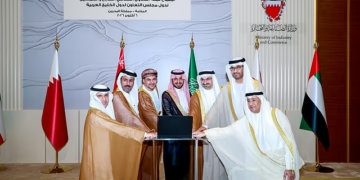
The decision was finalized during an emergency summit of senior diplomatic and defense officials in Riyadh. In a joint communiqué, representatives from Islamabad, Ankara, and Riyadh declared an immediate transition to the operational phase of the pact, pledging to assemble and dispatch agreed-upon combat formations and deterrent capabilities to bolster Saudi border defenses and sensitive infrastructure.
The trilateral alliance, concluded in August in Mecca and modeled conceptually on mutual-defense frameworks, treats an armed assault on one signatory as an attack on all three. While the communiqué refrained from explicitly naming Yemen’s Houthi movement, officials forcefully condemned recent projectile and drone assaults targeting Saudi sovereignty, specifically referencing threats directed near the holy cities of Mecca and Medina.



Military planners in Riyadh did not disclose the precise operational troop numbers or equipment schedules being mobilized, but regional defense officials confirmed that logistics and command integration are already underway under the alliance’s newly established joint secretariat.
The military mobilization coincided with major territorial shifts along the southern Red Sea corridor. In Yemen, internationally recognized government forces—spearheaded by the Giants Brigades, Nation’s Shield units, and local resistance factions with coalition air backing—recaptured the strategic port city of Mocha in Taiz province. The advance pushes Houthi fighters away from key maritime perimeters overlooking the Bab Al Mandeb Strait, an essential energy choke point where shipping lanes have faced sustained interdiction since early September.
The widening geopolitical strain continues to reverberate internationally, particularly over energy security and military posture.

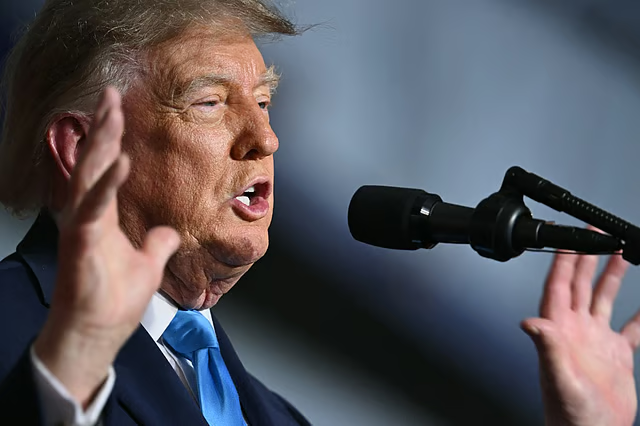
In the United States, President Donald Trump signed an executive order temporarily lifting federal and state restrictions on off-road, tax-exempt red-dyed diesel, allowing its use on public highways. Speaking in Grand Island, Nebraska, Trump framed the regulatory waiver as an emergency buffer for commercial haulers and agricultural producers confronting record diesel prices driven by the conflict with Iran.
Addressing broader regional tensions, Trump reiterated that Washington remains open to diplomatic dialogue with Tehran, even as he confirmed the withdrawal of American B-1 Lancer strategic bombers from Britain’s RAF Fairford due to non-public threat assessments linked to Iranian capabilities.
Tehran rejected the diplomatic overture. Iranian President Masoud Pezeshkian dismissed talk of negotiations as meaningless, stating that ongoing American and allied military strikes during past diplomatic intervals destroyed any basis for constructive dialogue.