

Tensions escalate in the Middle East following Washington’s naval blockade, while Tehran and Muscat attempt to revive transit negotiations.
WASHINGTON / TEHRAN — US President Donald Trump has asserted that Washington holds “total control” over the Strait of Hormuz, going as far as characterizing the vital international waterway as “American territory”. The statement came alongside warnings that Tehran will never be permitted to acquire nuclear capabilities, prompting swift backlash from Iranian officials who labeled Washington’s expanding economic sanctions a “declaration of war” against independent nations.
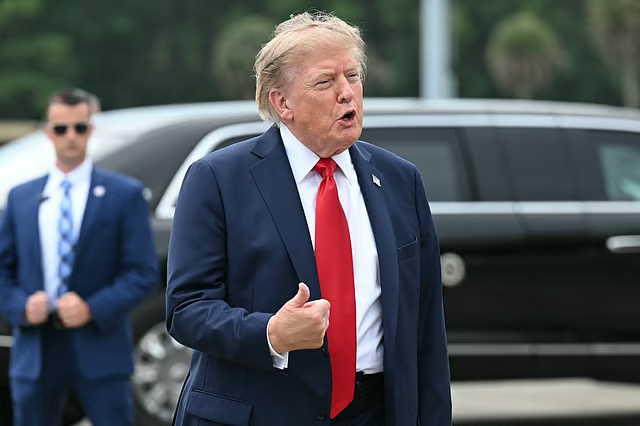
Addressing supporters at a rally in Myrtle Beach, South Carolina, and speaking earlier to reporters at Joint Base Andrews, President Trump highlighted the active US naval presence in the region. He claimed that Iran is eager to conclude a negotiating deal but remains unready to accept terms mandated by Washington.




“We cannot let them have a nuclear weapon,” Trump said. “They want to make a deal so badly, we don’t even know if we want [a deal] because I view the Strait of Hormuz as an American territory right now.”
The statements follow a series of actions by Washington aimed at enforcing a naval blockade and tightening economic isolation around Tehran. The administration recently threatened an “Economic D-Day,” warning foreign financial institutions, shipping registers, and trade hubs against facilitating commerce with Iranian entities.
Tehran responded firmly to the economic measures and maritime claims. Iranian Foreign Ministry spokesperson Esmaeil Baghaei condemned the secondary sanctions, stating that Washington’s attempts to dictate foreign banking and maritime transport constitute an unlawful assertion of “extraterritorial sovereignty”.
“This is a declaration of war on all independent nations,” Baghaei said in remarks carried by Iranian state media, adding that submitting to such unilateral pressure would risk a return to “full-scale classic colonialism.”
Officials in Tehran also dismissed Trump’s territorial claims over the maritime choke point, through which approximately one-fifth of global oil consumption flows. Mohsen Rezaei, head of Iran’s Supreme National Security Council, remarked on social media that the gap between Washington’s claims of ownership and its operational reality in the Persian Gulf remains vast. Meanwhile, Iranian Parliament Speaker Mohammad Bagher Ghalibaf reiterated that Iran would not reopen access to shipping lanes without a formal commitment from Washington to lift the economic blockade and unfreeze Iranian assets.
Diplomatic efforts to address the maritime crisis continue across regional capitals. Iranian Foreign Minister Abbas Araghchi held consultations with his Omani counterpart to discuss framework negotiations regarding safe passage through the Strait. Concurrently, US Secretary of State Marco Rubio met with Oman’s top diplomat as Muscat seeks to maintain its traditional role as a mediator despite growing political strain.