

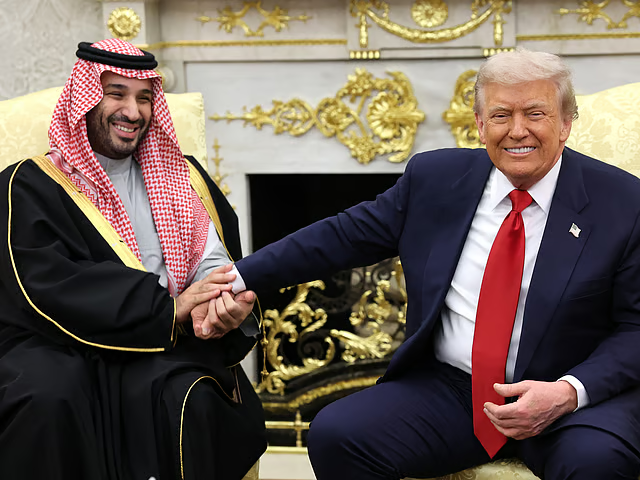

Washington ties a 30-year nuclear cooperation agreement with Riyadh to the kingdom joining the Abraham Accords, setting up a major foreign policy test amid congressional pushback.
WASHINGTON — US President Donald Trump announced Thursday that a newly negotiated civil nuclear cooperation agreement with Saudi Arabia will remain strictly contingent on the kingdom formally normalizing diplomatic relations with Israel under the Abraham Accords.
The assertion, made via a post on social media, adds a explicit geopolitical condition to a 30-year “123 agreement” signed in Washington on Wednesday by US Energy Secretary Chris Wright and Saudi Energy Minister Prince Abdulaziz bin Salman. While the deal establishes a framework for American firms to build Saudi Arabia’s civil nuclear infrastructure, it has immediately drawn sharp scrutiny on Capitol Hill and among nonproliferation experts over guardrails and regional balance.
“The agreement will be approved, but is totally subject to Saudi Arabia joining the very respected and successful Abraham Accords,” Trump stated, adding that Washington “is not opposed to Civil (Non-Enriched) Nuclear Facilities.”


The Saudi Embassy in Washington declined to comment on the president’s condition. Saudi officials have consistently maintained that diplomatic normalization with Israel depends on establishing a clear, viable pathway toward Palestinian statehood—a measure Israeli Prime Minister Benjamin Netanyahu has repeatedly rejected as incompatible with national security.
Netanyahu’s office issued a statement praising the prospect of Riyadh joining the Abraham Accords as a “historic leap forward for peace,” though it notably omitted any reference to the civil nuclear framework.
The nuclear package signed this week aims to anchor Saudi Arabia’s energy diversification strategy to American industry rather than geopolitical rivals. Speaking to reporters in Manila on Thursday, US Secretary of State Marco Rubio defended the economic and strategic rationale, stating that Washington needed to ensure American companies secured the contract over foreign competitors from China, Russia, South Korea, or France.

“We’re not the only show in town, but we’re the best show in town,” Rubio said. “We want to make sure that it’s our companies they’re picking.”
Despite administration efforts to frame the agreement as a win for domestic industry, details surrounding nonproliferation safeguards have sparked bipartisan pushback in Congress. People familiar with the text confirmed that the current draft does not incorporate the International Atomic Energy Agency’s (IAEA) “Additional Protocol”—a standardized oversight mechanism that grants inspectors expanded access to unannounced sites to ensure material is not diverted for weapons development.
Furthermore, while current terms prohibit immediate uranium enrichment, the framework leaves open the possibility of a joint US-Saudi study to examine constructing a uranium enrichment facility within the kingdom at a later date.
Capitol Hill lawmakers from both parties have voiced deep concern over granting nuclear capabilities without strict, permanent bans on domestic enrichment. Democratic Representative Brad Sherman highlighted previous legislative efforts co-sponsored by Rubio during his time in the Senate that sought mandatory congressional approval for any Saudi nuclear deal, urging the State Department to maintain rigorous oversight standards.
White House Press Secretary Karoline Leavitt confirmed during a news briefing that the text, alongside a bilateral safeguards agreement, will be submitted to Congress for statutory review. Leavitt reiterated that President Trump remains firm on requiring diplomatic normalization before final execution.
The Saudi Ministry of Energy reiterated Wednesday that the deal supports efforts to “diversify energy sources, advance cutting-edge technologies, and expand opportunities for cooperation,” positioning the program as a cornerstone of the kingdom’s Vision 2030 economic transformation.