

Speaking alongside UN and UK envoys at the Human Rights Council, Education Minister Sarah Al Amiri affirms the UAE’s 2028–2030 Council bid and calls for urgent action to close global gender gaps.
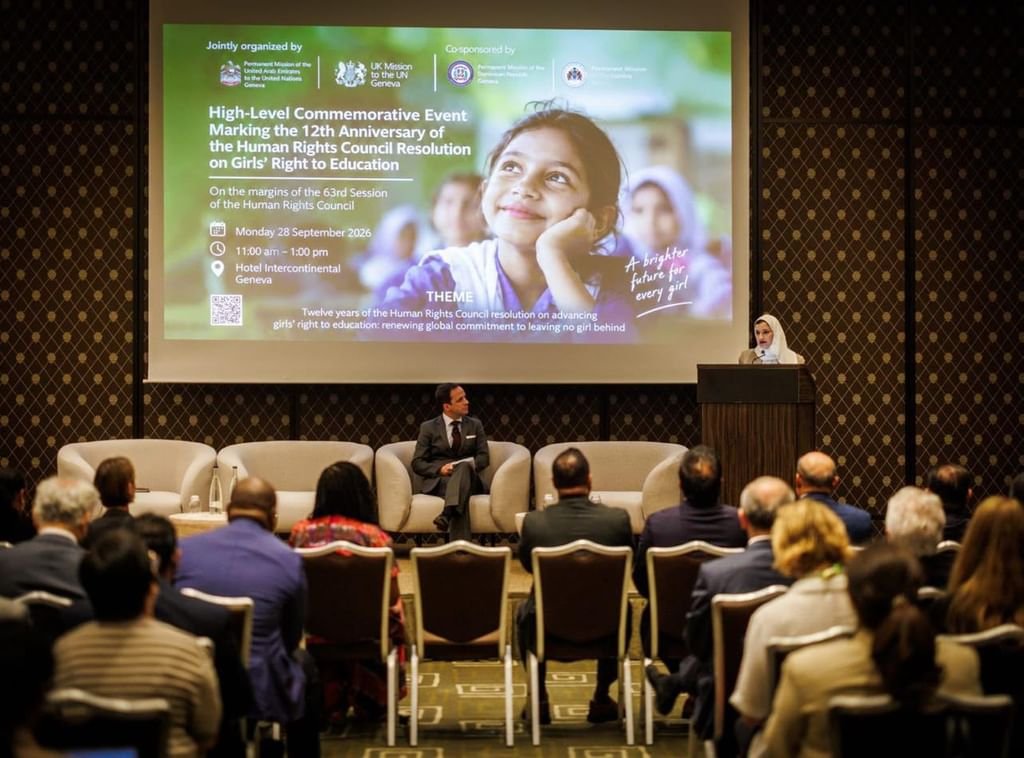
GENEVA — October 2, 2026 : Every girl worldwide must be guaranteed at least 12 years of safe, equitable, and quality schooling that provides real personal agency rather than just a basic qualification, UAE Minister of Education Sarah Al Amiri told diplomats and UN officials in Geneva on Friday.
Addressing a high-level diplomatic meeting on the sidelines of the 63rd session of the UN Human Rights Council, Al Amiri urged governments to turn historic resolutions into measurable classroom outcomes, particularly in regions hit by armed conflict, poverty, and systemic gender disparities.

The panel was convened jointly by the Permanent Missions of the United Arab Emirates and the United Kingdom, alongside co-sponsors the Dominican Republic and The Gambia. Held under the theme “Renewing Global Commitment to Leave No Girl Behind,” the session marked 12 years since the Council adopted its landmark 2014 resolution enshrining girls’ equal right to schooling.



Al Amiri framed access to schooling not merely as a milestone on paper, but as an essential catalyst for long-term economic independence.
“Our ambition should remain clear: every girl should have access to and complete at least twelve years of safe, inclusive, equitable and quality education,” Al Amiri said during her opening address. “Education should do more than give her a qualification. It should give her the knowledge, skills and agency to decide what comes next.”
She also formally linked these education priorities to the Emirates’ diplomatic agenda in Geneva, noting the country’s bid for a seat on the UN Human Rights Council for the 2028–2030 cycle. The UAE has previously served three terms on the 47-member body.
“As the UAE seeks membership of the Human Rights Council for the 2028–2030 term, we do so with a commitment to continue contributing to this work,” Al Amiri said, adding that the candidacy reflects a desire to expand partnerships safeguarding fundamental rights globally.
Opening contributions were also delivered by Awa Dabo, Deputy United Nations High Commissioner for Human Rights, and Kumar Iyer, the UK’s Ambassador and Permanent Representative to the UN in Geneva. Both speakers emphasized that systemic shocks—ranging from economic downturns to forced displacement—continue to disproportionately push adolescent girls out of the classroom.
Technical specialists from UNICEF, UN Women, and UNESCO’s International Bureau of Education briefed delegates on the practical challenges facing vulnerable learners. Their presentations zeroed in on instructional continuity during humanitarian emergencies, eliminating legal and social barriers to schooling, and addressing the widening digital divide that leaves millions of young women without technical skills.
The dialogue, moderated by University for Peace Permanent Observer David Puyana, brought grassroots perspectives directly to senior diplomats. Contributions included testimony from a youth advocate from Malawi on overcoming community-level educational hurdles, alongside remarks by Emirati inventor Mariam Al Ghafri on opening modern science and innovation pathways for young women.
Delegates noted that while global completion rates have climbed since the initial 2014 resolution, conflicts across Africa, the Middle East, and parts of Asia have rolled back decades of progress. Closing the event, participating states affirmed that international pledges must translate into direct financing for rural schools, robust safety protections for female students, and curriculum modernizations tailored for future employment.