

The Central Board introduces structural changes for Classes 9 and 10 in line with NEP 2020; school-based internal evaluation to replace Board exams for the third language, with significant exemptions granted for UAE and overseas institutions.
NEW DELHI — In a major structural overhaul of secondary education, the Central Board of Secondary Education (CBSE) has finalized the implementation guidelines for its mandatory three-language framework. Starting from the 2026–27 academic session, all affiliated schools must integrate a third language (R3) at the secondary stage beginning with Class IX, effective from July 1, 2026.
The policy shift, orchestrated in strict alignment with the National Education Policy (NEP) 2020 and the National Curriculum Framework for School Education (NCFSE) 2023, aims to promote multilingual learning and deep cultural rootedness. Under the newly structured framework, languages will be categorized as R1 (primary language), R2 (second language), and R3 (third language), ensuring that every learner studies at least two native Indian languages during their secondary schooling.
Phased Implementation and Transitional Arrangements
To minimize academic disruption for the upcoming cohort, the CBSE has mapped out a phased rollout plan that begins with a flexible transitional phase before moving into full compliance:


- Academic Year 2026–27: R3 becomes compulsory for Class IX. Under transitional guidelines, these students will study Class VI-level R3 textbooks supplemented by one local or state literary text.
- Academic Year 2027–28: The compulsory rule expands to cover both Classes IX and X. Class X students during this period will utilize Class VII-level materials alongside regional texts.
- Academic Year 2028–29 Onwards: Full implementation of the dedicated secondary-stage R3 curriculum will take effect.
The Board confirmed that newly tailored R3 textbooks for Class VI will be available to schools by June 2026, while advanced Class IX-level materials for subsequent batches will be released by December 2026. Illustrative permissible combinations shared by the Board include pairings such as Hindi (R1) + English (R2) + Malayalam (R3) or Telugu (R1) + English (R2) + Sanskrit (R3). Students who have not studied any native Indian language in Classes VI–VIII are explicitly required to select a native language as their R3 component.
Crucial Exemptions for UAE and Overseas Schools
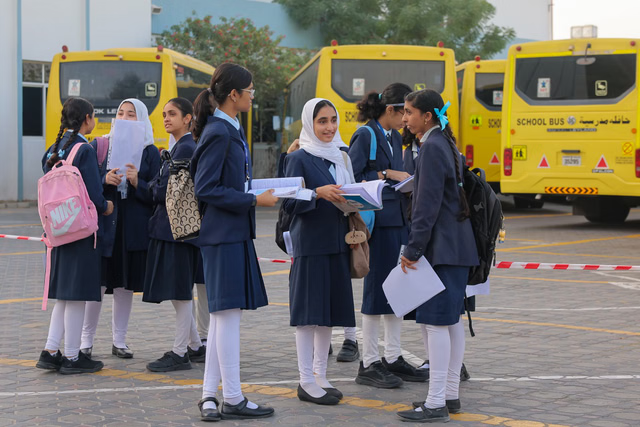
Recognizing the diverse demographics of expatriate student populations, the CBSE has introduced vital flexibilities and exemptions for international formatting. CBSE-affiliated schools in the UAE and other overseas territories will benefit from relaxed language selection criteria.
Specifically, schools operating outside India may be completely exempt from the strict requirement of offering two native Indian languages, though they must still adhere to the operational R1, R2, and R3 structural system. Furthermore, case-by-case exemptions from the native language requirements will be extended to foreign students, transient students, and Children with Special Needs (CwSN) in accordance with global academic provisions.

Low-Intensity Assessment Strategy to Curb Student Stress
Addressing concerns regarding the curriculum load on students managing dual-level Mathematics and Science courses, the CBSE clarified that R3 will be treated as a low-intensity subject. It will occupy only two to three periods per week, prioritizing basic oral communication, reading, and conversational fluency over extensive grammatical drilling or essay writing.
“To keep the focus on learning and reduce any undue pressure on students, no Board Examination shall be conducted for R3 at the Class X level,” the CBSE notification stated.
Instead, evaluation will be purely school-based through internal assessments, resulting in a “Qualified/Not Qualified” status on the student’s final certificate. While a student cannot be barred from taking the Class X Board Examinations due to an incomplete R3 assessment, clearing the subject internally remains a mandatory prerequisite for the final award of the CBSE pass certification. Schools that fail to qualify will be required to provide remedial support, with academic performance captured qualitatively through internal grades (A–E) within the Holistic Progress Card.
Mitigation Plans for Teacher Shortages and Compliance Timelines
To counter immediate logistical bottlenecks, such as acute shortages of specialized regional language teachers, the Board has advised schools to utilize collaborative regional academic support systems. These include inter-school resource-sharing via Sahodaya hubs, digital classrooms, guest faculty, and the recruitment of qualified retired language specialists or functionals.
All affiliated school administrations have been strictly instructed to update their definitive R3 language options on the official OASIS portal by June 30, 2026, ensuring complete compliance with the prescribed educational timeline.