


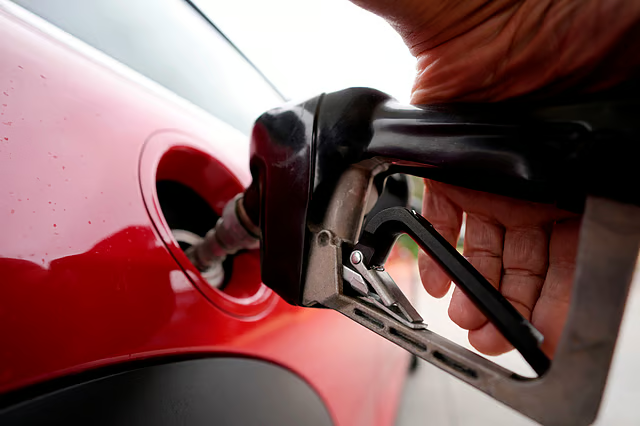
As Brent crude cools down from its peak, economists predict a gradual easing of fuel costs rather than a sharp drop, citing prolonged geopolitical risks and shipping bottlenecks.
DUBAI — After four consecutive months of escalating fuel prices, UAE motorists looking for immediate relief at the pumps may have to wait a little longer. While global oil markets are finally showing signs of cooling down, energy experts and economists warn that a return to significantly cheaper fuel remains a distant prospect.

For the month of June, the UAE fuel price committee implemented yet another hike, driving Super 98 to Dh3.95 a litre, Special 95 to Dh3.83, and E-Plus 91 to Dh3.76. Conversely, diesel offered a minor respite, easing to Dh4.33 per litre. The consecutive hikes mean that Super 98 has surged by over 61% since February, when it stood at Dh2.45 per litre. For an average motorist filling a 60-litre tank, this translates to an expense of Dh237 per refill—roughly Dh90 more than at the start of the year.
Why UAE Fuel Prices Remain Elevated
The primary catalyst behind the sustained high pricing is the volatility of the global crude market. Although Brent crude has retreated to around $97 a barrel—down from the tumultuous $110–$120 levels seen earlier this year—prices remain high due to lingering geopolitical uncertainties.


The conflict involving Iran and ongoing security threats surrounding the Strait of Hormuz continue to weigh heavily on supply chains. Given that this critical waterway handles approximately 20% of the world’s global oil supply, any friction directly ripples across international energy sectors.
While recent diplomatic progress, including US-Iran negotiations and ceasefire efforts, has mitigated panic buying and pulled Brent crude below the $100 threshold, experts suggest that market corrections will be slow.
The Timeline for Relief: A Gradual Cooling
Because the UAE utilizes a deregulated monthly fuel-pricing mechanism tied directly to global averages rather than daily fluctuations, changes in the crude market take time to filter down to consumers. Motorists may need to navigate several pricing cycles before observing a meaningful drop.
Gita Gopinath, Deputy Managing Director of the International Monetary Fund (IMF), indicated that a rapid decline to pre-conflict pricing is unlikely.
“We are not going to see the price of oil come down all the way very quickly,” Gopinath stated. “It’s going to take probably till the middle of next year for oil to come back to say $70 or $75 a barrel. There is going to be an effect lasting into next year.”
If Brent crude stabilizes within the $90–$100 range, UAE fuel prices are expected to plateau rather than plummet. A decisive shift back toward the $70–$75 window is required to trigger substantial reductions at local petrol stations.
Protracted Risks and Global Growth Projections
The path to economic normalization remains fraught with risk. Financial institutions warn against premature optimism, noting that prolonged disruptions could quickly reverse recent market improvements.

Gopinath cautioned that if shipping bottlenecks extend for another month, crude could spike back up to $120 or $140 a barrel, exacerbating global inflationary pressures.
This sentiment is echoed by the Organisation for Economic Co-operation and Development (OECD). Stefano Scarpetta, an official representing the 38-member intergovernmental body, emphasized the compounding economic tolls:
“The longer the disruption lasts, the greater the economic, but also the social cost of this crisis.”
According to the OECD, global economic growth is projected to slow to 2.8% if Gulf oil and gas exports stabilize later this year. However, if supply chain disruptions persist into 2027, global growth could contract sharply to 2.1%, putting several vulnerable economies at risk of recession.
What Lies Ahead for Consumers?
For the global audience and Gulf expatriates monitoring the situation, the consensus points toward stabilization rather than immediate relief. The era of aggressive, consecutive price spikes appears to have paused, making way for a phase of gradual market cooling.
Barring any renewed escalations in the Gulf region, motorists can expect fuel prices to flatten out in the coming months, with significant downward adjustments conditional upon a sustained recovery of global crude supplies.