

Major corridor upgrade linking Sharjah and Dubai will handle 4,000 vehicles per hour, cutting peak waiting times by up to 85%
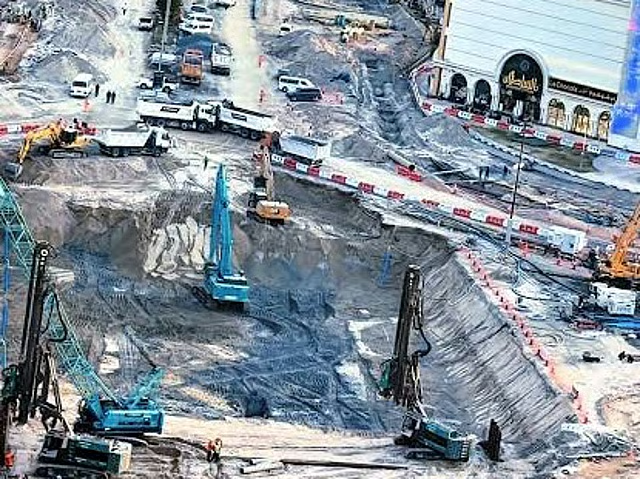
SHARJAH — September 1, 2026: Sharjah will commission the first phase of the Al Taawun Tunnel in November 2026, delivering crucial traffic relief along one of the busiest commuter corridors connecting the emirate to Dubai.
The project at Al Taawun Square features three lanes in each direction, engineered to accommodate roughly 4,000 vehicles per hour during peak travel periods. Once fully operational in February 2027, the infrastructure is projected to slash motorist wait times by up to 85 per cent.
The Sharjah Roads and Transport Authority (SRTA) designed the tunnel to eliminate persistent bottlenecks between Al Taawun, Al Nahda, and Dubai. Construction has been running around the clock following a 20 per cent completion milestone recorded in July.



The tunnel forms part of a broader arterial modernization scheme linking critical road networks across Al Taawun and Al Khan to Sheikh Mohammed bin Zayed Road. The initial phase of this broader transit corridor will also open in November.
SRTA is simultaneously advancing another major road intervention: a Dh140-million three-lane flyover at the junction of Sheikh Khalifa bin Zayed Street and Mleiha Road. That development aims to streamline transit flow toward Sheikh Mohammed bin Zayed Road while significantly reducing travel times between central Sharjah and the interior areas of Mleiha.
Yousif Khamis Al Othmani, Chairman of SRTA, stated that the emirate is executing an integrated transport strategy that couples physical road expansion with smart technology and sustainable public mobility.

As part of sustainable construction practices, the authority is broadening its application of recycled asphalt—a technique adopted in 2021 that repurposes recovered road materials to accelerate paving timelines and curb raw aggregate consumption.
Alongside highway construction, Sharjah’s public transit network is seeing a structural shift. The emirate’s public transport fleet now deploys electric, hybrid, and compressed natural gas vehicles. Electric transit units utilize artificial intelligence systems to process live operational telemetry and elevate passenger safety.
On-demand transit is expanding concurrently. The SRTA Bus on Demand digital service provides app-based hailing in Muwaileh Commercial, Aljada, University City, Al Juraina, Al Qarain, and Al Nouf, offering targeted connectivity to neighborhoods outside traditional fixed routes. AI-powered interior and road-facing camera systems have also been deployed across intercity buses and taxis to monitor driver fatigue, driving behavior, passenger density, and lost property.