

Known as ‘Thenisai Thendral’, the composer helped define Rajinikanth’s cinematic aura and brought Chennai’s gaana tradition to mainstream Indian cinema
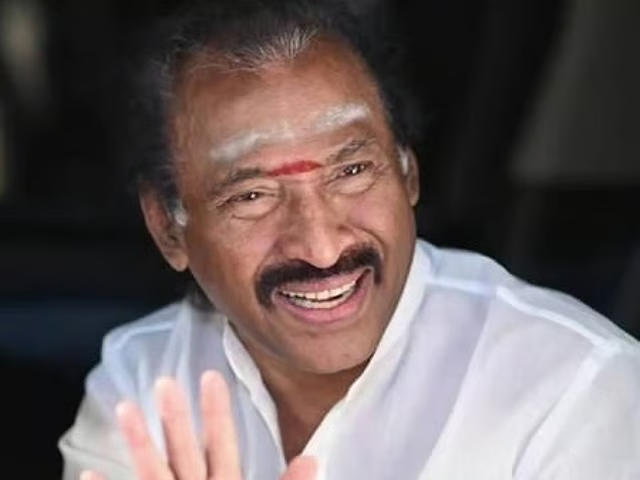
CHENNAI, Oct 17 : Veteran Indian composer and playback singer Devanesan Chokkalingam, revered across South Indian cinema by the single name Deva, died in Chennai on Saturday after suffering a heart attack. He was 75.
Deva complained of severe chest pain early Saturday morning and was rushed to Surya Hospital in Kodambakkam around 8:30 a.m. Attending doctors said he could not be revived despite emergency resuscitation efforts.
His death prompted an immediate outpouring of tributes across the South Indian film industry, where he spent more than three decades shaping the acoustic identity of Tamil commercial cinema. Fondly titled Thenisai Thendral—breeze of sweet music—Deva composed scores and songs for upwards of 400 feature films across Tamil, Telugu, Kannada, and Malayalam.


He was best known for his defining creative partnership with superstar Rajinikanth during the 1990s. Deva composed the landmark scores for Annamalai (1992), Baashha (1995), and Arunachalam (1997). His brass-heavy Baashha background theme and Rajinikanth’s title introduction music became indelible fixtures of popular culture, while the upbeat track Naan Autokaaran turned into an enduring working-class anthem throughout Tamil Nadu.
Beyond mass action themes, Deva held a singular place in film history for elevating Chennai’s native gaana music—a raw, rhythmic street-folk tradition rooted in the city’s working-class northern neighbourhoods—into mainstream film soundtracks.
At a public appearance earlier this year, Deva recalled entering the industry at a time when Ilaiyaraaja was firmly dominant and A.R. Rahman was emerging as a global force. “Any song I composed would either sound like a song composed by Raaja or, if I scored a western number, it would sound like Rahman,” he observed. “It was under these circumstances that I wanted an identity for myself and therefore brought the gaana songs.”
That stylistic choice transformed Tamil film music in the 1990s. Deva sang many of his own gaana compositions, pairing colloquial street Tamil with urgent, percussive arrangements that immediately registered with common listeners.
Born on November 20, 1950, Deva trained under classical musician Dhanraj before studying Western music theory. His early professional work included composing devotional songs, private stage performances, and television tracks for Doordarshan Podhigai’s agricultural show Vayalum Vaazhvum.

He entered feature films with Maatukaara Mannaru (1986) before securing mainstream critical recognition with Manasukketha Maharaasaa (1989) and the 1990 romantic drama Vaikasi Porandhaachu.
His versatility kept him at the top of the industry throughout the decade. Deva delivered breezy, sophisticated melodies for Kamal Haasan comedies such as Avvai Shanmugi and Panchathanthiram, alongside chart-topping romantic scores for Ajith Kumar’s Aasai, Kadhal Kottai, and Vaalee, Vijay’s Nerrukku Ner and Kushi, and Murali’s Ninaithen Vandhai. Outside Tamil cinema, he scored notable Malayalam projects including Mohanlal’s The Prince (1996) and Mammootty’s Phantom (2002).
Beyond commercial projects, Deva served as chairman of the Tamil Nadu Eyal Isai Nadaka Mandram and scored the 2010 film Sivappu Mazhai, which entered the Guinness World Records for the fastest full-length film production from script to screen.

Deva’s musical footprint carried through his family: his son Srikanth Deva became a film composer, while his brothers Sabesh and Murali worked extensively as a background-scoring duo.
Funeral arrangements are being finalized at his residence in Chennai, where film personalities and political figures have begun gathering to pay homage.