


New restrictions target social media content in sensitive zones; unauthorised filming could lead to device confiscation and travel bans.
DUBAI — For the millions of Non-Resident Indians (NRIs) and global tourists flying between the UAE and India, capturing spontaneous airport moments for social media could now result in severe legal consequences. The Directorate General of Civil Aviation (DGCA) in India has significantly tightened regulations regarding photography and videography across all Indian aerodromes, warning that unauthorized filming could lead to heavy penalties, including placement on the national no-fly list.

The regulatory shift comes in response to an exponential rise in travel vlogs, Instagram reels, and live streams recorded inside airport premises. Aviation security authorities have raised concerns that even seemingly harmless social media content can inadvertently capture sensitive operational workflows, surveillance layouts, security checkpoints, and restricted infrastructure, thereby compromising national transport security.
Strict Enforcement in Operational Zones
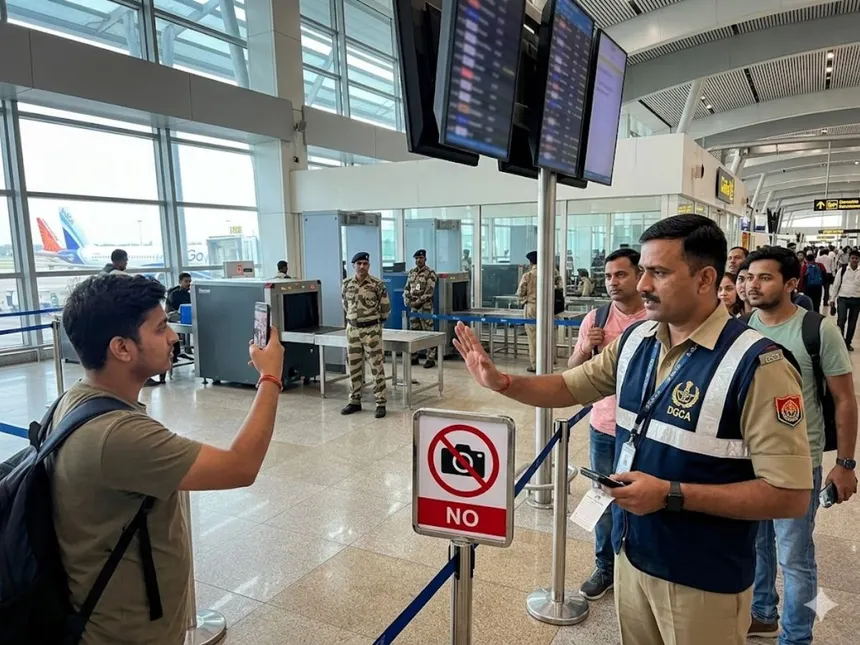
Under the updated DGCA guidelines, passengers are strictly prohibited from taking photographs or recording videos in sensitive institutional zones. These restricted areas include security screening points, immigration counters, baggage handling areas, and active runways or tarmacs. The primary objective is to prevent the accidental public exposure of critical surveillance infrastructure and security protocols.


While photography remains permissible in general public spaces—such as primary terminal concourses, retail areas, and passenger lounges—travelers are urged to exercise extreme caution and strictly adhere to all structural signage and instructions from airport staff. Officials have emphasized that security-related infractions will be treated as serious operational offenses rather than minor social media oversights.
Escalated Penalties and No-Fly List Implications
The penalties for violating these civil aviation directives are stringent. Passengers found filming in unauthorized zones face immediate device confiscation, hefty financial fines, and rigorous questioning by security agencies.
Furthermore, serious or repeated non-compliance can escalate to an official travel ban. Under India’s civil aviation regulations, individuals deemed a security risk or those who willfully disrupt order through unauthorized surveillance activities can be placed on the DGCA’s no-fly list, effectively barring them from booking domestic or international flights to and from India for a designated duration.
Guidelines for Foreign Crews and Commercial Content
The directive also outlines rigid compliance measures for professional and international entities. Foreign airline crews are explicitly barred from engaging in any form of photography or videography unless they have obtained prior security clearance from relevant Indian intelligence and security agencies. Furthermore, comprehensive records of all sanctioned photography activities must be meticulously maintained by airport operators for a minimum period of three years and made readily available for DGCA inspection upon demand.
Similarly, social media influencers, digital content creators, and commercial production houses planning brand campaigns, documentaries, or professional travel features must secure formal, written permissions from both airport authorities and central security agencies well in advance. No exemptions will be granted for commercial or high-profile digital content creation without formal validation.
Advisory for Global Travelers
With the high volume of daily flights connecting major UAE hubs like Dubai and Abu Dhabi to various international airports across India, aviation experts advise passengers to prioritize operational compliance over digital engagement. Travelers are recommended to keep recording devices stowed away during immigration, security screening, and boarding processes to eliminate the risk of accidental non-compliance and subsequent travel disruption.