


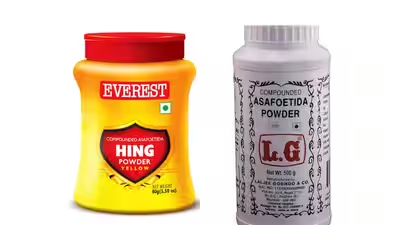
Laboratory tests reveal products contained up to 40 percent less raw asafoetida than mandated by national food safety standards
NEW DELHI — September 3, 2026 : India’s apex food safety regulator has banned the sale of compounded asafoetida, commonly known as hing, produced by prominent kitchen spice manufacturers Everest Food Products and Laljee Godhoo & Co. (LG), after laboratory tests confirmed the products fell far below statutory quality benchmarks.
The Food Safety and Standards Authority of India (FSSAI) issued a nationwide prohibition order following a targeted market surveillance campaign triggered by a consumer grievance. Initial tests raised quality red flags, prompting central authorities to launch formal regulatory sampling drives across primary manufacturing hubs in Maharashtra and Gujarat.
Food safety officers seized legal samples directly from the centrally licensed facilities of Everest Food Products Private Limited and the LG Brand Unit in Mumbai. In a coordinated operation, the central regulator also teamed up with the Gujarat Food and Drug Control Administration (FDCA) to inspect and collect test batches from Everest’s state-licensed manufacturing plant in Umbergaon, Gujarat.




Subsequent primary laboratory analyses confirmed that every legal batch seized across these facilities failed regulatory thresholds.
Under the Food Safety and Standards (Food Products Standards and Additives) Regulations, 2011, compounded hing is defined as an edible formulation combining raw asafoetida with gum arabic, edible starches, and cereal flours. To ensure authentic potency and prevent excessive filler dilution, the law mandates a minimum addition of raw hing that must yield at least a 5% alcohol-soluble extract in the final packaged product.
Test results from the accredited government laboratory revealed that the samples registered an alcohol-soluble extract of only 0% to 3%, breaching the statutory 5% baseline. The deficit indicates that both processors cut the proportion of genuine raw asafoetida by 30% to 40%, relying heavily on fillers instead.
The prohibition order forces immediate withdrawal of the affected production batches from wholesale networks, grocery shelves, and e-commerce platforms. State enforcement wings have been instructed to monitor local supply chains and seize non-compliant inventory.