


Tehran targets Camp Titin and regional facilities in retaliatory barrage as host nations scramble air defences; US officials report no initial American casualties
WASHINGTON / DUBAI — September 2, 2026 : Iran launched a wave of ballistic missiles and explosive drones at American military positions across Jordan, Kuwait, and Bahrain early Wednesday, sharply escalating regional hostilities hours after the United States carried out precision strikes on Iranian military assets.

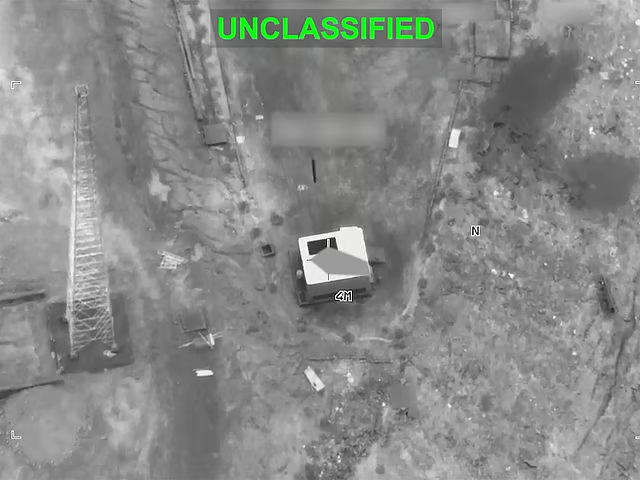
The Islamic Revolutionary Guard Corps announced the retaliatory barrage in a statement via Iranian state media, claiming it targeted multiple facilities housing American forces. The barrage hit the region following US Central Command airstrikes conducted on September 1, which pounded IRGC air defence positions, early-warning radar arrays, naval installations, mine-laying assets, and communications hubs. Washington said those operations responded directly to Iranian attempts to mine commercial transit routes in the Strait of Hormuz and target American personnel.

Tehran claimed its Aerospace Force executed a heavy ballistic missile strike on Camp Titin, a training and support facility near the Gulf of Aqaba in southern Jordan. Iranian military spokespersons claimed substantial structural destruction and troop casualties. However, the Jordanian Armed Forces contradicted those claims, confirming that Jordanian air defences intercepted 10 inbound Iranian ballistic missiles, while three others struck deserted terrain without causing injuries. In Washington, two US defence officials briefed on the matter stated that early assessments confirmed no American casualties.


The confrontation spilled across the Arabian Gulf, activating air defence batteries throughout Kuwait. Kuwait’s military said its interceptors engaged swarms of hostile drones and incoming missiles, causing mid-air detonations heard across residential areas. Military authorities in Kuwait City confirmed that while falling shrapnel caused minor ground damage, no critical casualties were recorded. Air-raid sirens also sounded in Bahrain, home to the US Navy’s Fifth Fleet headquarters, as regional defensive grids tracked incoming aerial threats. Commercial aviation faced immediate disruptions; an international flight bound for Bangkok from Tel Aviv was forced to execute a mid-air diversion away from Jordanian airspace.
The swift military exchange places the wider region on high alert. Gulf capitals have reinforced defensive protocols, while US combat commands monitor for secondary missile volleys. CENTCOM officials warned that any continued strikes against American military facilities or international maritime corridors would meet decisive defensive retaliation.