


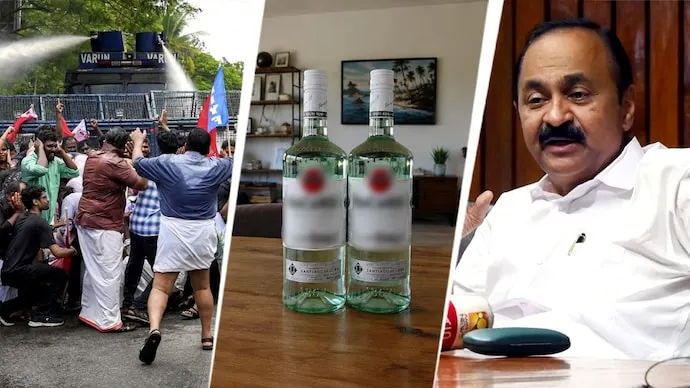
Chief Minister clarifies lower slabs for mild beverages are futuristic fiscal frameworks, assuring allies no sales will begin without a unified UDF liquor policy.
DUBAI: Defending his administration’s maiden fiscal layout against mounting political heat, Kerala Chief Minister V.D. Satheesan has stood firm on the state budget’s proposal to restructure taxes for low-alcohol beverages. Addressing concerns within the ruling United Democratic Front (UDF) coalition and blistering attacks from the Left opposition, the Chief Minister clarified that the new tax slabs are merely part of a futuristic fiscal framework. He emphasized that actual marketing and sales of mild liquor will remain strictly frozen until a comprehensive and consensus-driven state liquor policy is officially formulated.

The political storm ignited following the presentation of the 2026 Revised Budget, which introduced a distinct tax system for drinks containing lower volumes of alcohol. Under the new guidelines, beverages with an alcohol strength between 0.5% and 10% will attract a sales tax of 120%, while those between 10% and 20% will be taxed at 175%. Previously, these casual lifestyle drinks were subject to the flat 251% sales tax imposed on potent Indian-Made Foreign Liquor (IMFL), making their market entry unviable.


The opposition, led by former Chief Minister Pinarayi Vijayan, quickly weaponized the decision, accusing the Congress-led government of bowing to corporate liquor lobbies and warning that cheaper, mild drinks would drastically spike addiction rates. However, hitting back at the allegations, CM Satheesan reminded the Assembly that the structural groundwork for low-alcohol options was originally laid down in 2022 by the previous Left Democratic Front (LDF) government itself.
Seeking to soothe anxious alliance partners like the Indian Union Muslim League (IUML) and various socio-religious bodies, senior cabinet ministers have stepped in to offer assurances of due process. State Excise Minister M. Liju confirmed that his department would reject immediate brand registration applications for mild beverages under current rules. Revenue Minister A.P. Anil Kumar echoed this stance, stating that any definitive move regarding sales would follow thorough, democratic deliberations within the UDF high command.
The Fiscal & Social Balance: Kerala has historically maintained some of the highest tax rates on alcohol in India, with uniform levies of 251% acting as a primary revenue driver for the cash-strapped state. Proponents of the tax calibration argue that encouraging a cultural pivot from hard spirits (which average 42.86% alcohol by volume) to mild beverages containing under 10% alcohol serves as a vital harm-reduction strategy, closely mirroring global public health standards.