


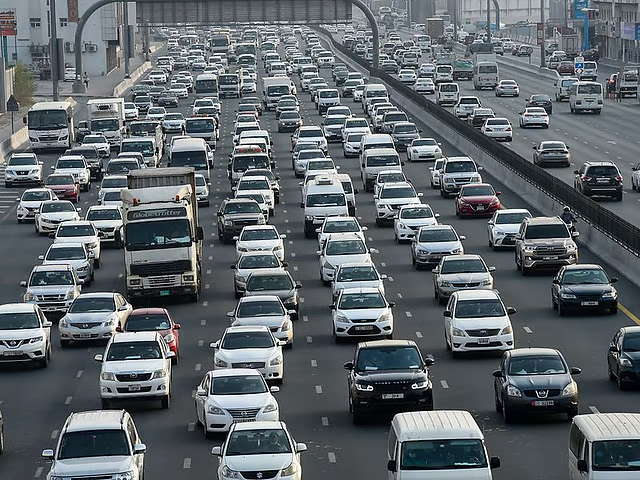
Live navigation data points to significant delays across cross-border commuter choke points, while internal Dubai routes maintain steady flow.
DUBAI, September 17, 2026 : Commuters traveling between Sharjah and Dubai faced protracted morning delays on Thursday as heavy vehicle volume backed up major transit arteries, most notably along Al Ittihad Road and Sheikh Mohammed bin Zayed Road.
Tailbacks stretched through critical commuter interchanges starting early Thursday morning. Live navigational data and roadside tracking showed acute congestion along the E11 (Al Ittihad Road) heading into Dubai, with stop-and-go conditions beginning near Sharjah City Centre and extending past the border approaches.

A similar pattern emerged along Sheikh Mohammed bin Zayed Road (E311). The highway experienced slow-moving bottlenecks northbound toward Sharjah as well as southbound choke points near the border intersection, where feeder routes funnel bulk industrial and residential traffic.


Inside Sharjah, surface street congestion compounded highway bottlenecks. Major hold-ups were recorded across Al Nahda, Al Khan, and key sectors of the Sharjah Industrial Areas, with vehicles stacking up at signalized junctions and roundabout bypasses.

By contrast, Dubai’s internal grid held steady throughout the peak commute. Arterials serving central business hubs remained largely clear. Mild to moderate patches of slowing surfaced along the perimeter of Dubai International Airport, around Al Qusais, and near Dubai Safari Park along southern legs of the E311.
Transit authorities and traffic monitoring units continue to advise inter-emirate commuters to leave early, maintain safe braking distances during sudden tailbacks, and consider secondary bypass options like Emirates Road (E611) to avoid gridlock across central border bottlenecks.