


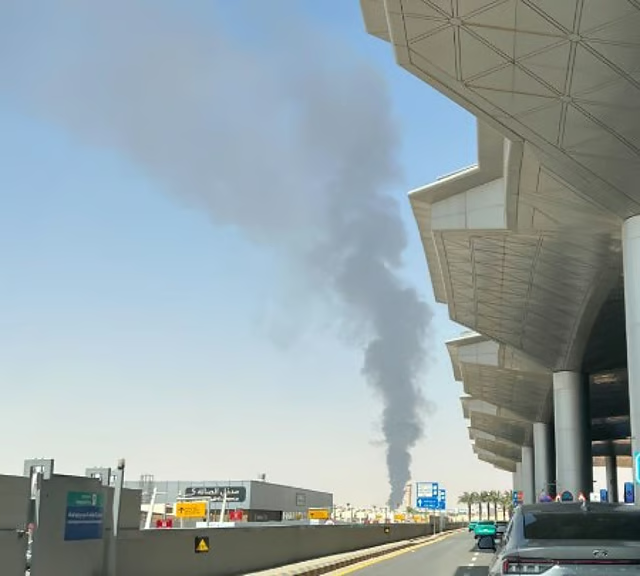
More than 40 percent of departures from King Khalid International Airport cancelled as regional and global carriers suspend services
RIYADH, Oct. 9 : A wave of cross-border strikes launched from Yemen against Saudi airports has forced international and domestic carriers to cancel hundreds of flights to and from Riyadh, leaving King Khalid International Airport facing its worst operational disruption in months.
The attacks, which targeted the capital’s main international hub and Abha International Airport in the kingdom’s southwest, killed three people and wounded dozens, triggering rolling airfield closures and immediate schedule suspensions across the aviation sector.
Runways at King Khalid International Airport were intermittently shut and reopened as security protocols halted arrivals and departures. By late afternoon on Thursday, 169 of 378 scheduled outbound flights—nearly 45 percent—had been cancelled or grounded, according to aviation analytics firm Cirium. Inbound traffic faced a similar hit, with 124 of 369 arriving services cancelled.



Saudi Arabia’s flag carrier, Saudia, absorbed the brunt of the groundings. Cirium tracked 97 cancelled departures out of 140 scheduled Saudia services from Riyadh—a failure rate exceeding 69 percent. The airline also cancelled 87 of its 136 scheduled inbound services. Domestic budget carriers felt immediate pressure: Flynas saw roughly a third of its outbound operations cancelled, while Flyadeal scrapped 20 of its 54 departures.

Global and regional carriers responded swiftly to the security risk. Air India cancelled operations to and from Riyadh through October 10, while Air India Express scrubbed all scheduled services from the Saudi capital. IndiGo and EgyptAir grounded dozens of rotations. Philippine Airlines halted flights to the capital through at least October 11, and Singapore Airlines deferred its scheduled route debut until late March. Hong Kong’s Cathay Pacific extended its suspension of flights into both Riyadh and Dubai through January 31.
Regional operators showed a fragmented response. Turkish Airlines grounded all four of its scheduled departures and four arrivals at Riyadh. Qatar Airways cut three of eight services, while flydubai halted one of its three scheduled rotations. In contrast, United Arab Emirates flag carriers Emirates and Etihad Airways operated their scheduled Riyadh itineraries without cancellations, according to tracker data.
The strikes strike at a sensitive geographic crossroads for international aviation. Over recent years, air operators have relied heavily on Saudi Arabian airspace as a critical transit route to bypass riskier corridors above Iran, Iraq, Syria, and Jordan. With central and southern Saudi airports now directly targeted, dispatchers face tightening flight corridors, mounting insurance surcharges, and costly rerouting over the Arabian Peninsula.
Airport authorities and airline operational centers continue to monitor the threat level before restoring full schedules. Ground staff in Riyadh have advised passengers not to travel to terminals without reconfirming departure status with their airlines.