


































As NASA prepares for a new era of human space exploration, scientists say robotic missions are playing a crucial role in making future journeys to the Moon and Mars safer and more sustainable. Speaking at a press briefing during the American Geophysical Union (AGU) meeting on December 17, researchers highlighted how data from existing robotic missions are helping solve real-world challenges astronauts will face beyond Earth.

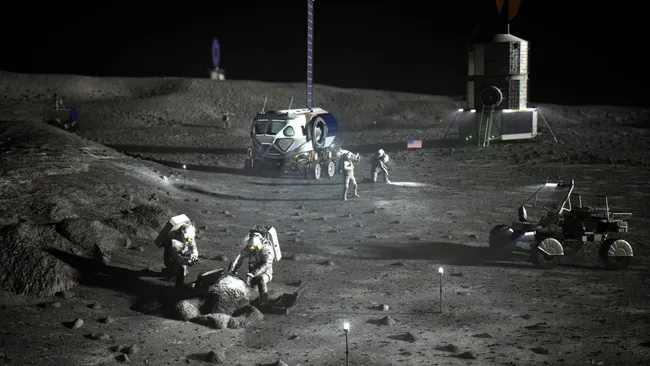
With renewed political momentum for human spaceflight — including plans to return astronauts to the Moon by 2028 and establish the foundations of a permanent lunar base by 2030 — scientists are adapting tools originally built for Earth to support off-planet exploration. These efforts focus on key challenges such as radiation exposure, water availability and hazardous dust.
One major advancement involves space weather monitoring. NASA scientists have expanded a decision-support system, originally designed to track solar activity near Earth, to include data from Mars missions. The tool combines information from the MAVEN orbiter and the Curiosity and Perseverance rovers, allowing astronauts to assess radiation risks on Mars in near real time.
Long-term datasets from the MAVEN mission are also helping researchers understand how radiation levels vary across an entire solar cycle. This information is critical for planning future crewed missions and designing protective systems for astronauts.
Another priority is locating water on the Moon, particularly near the lunar south pole where NASA plans to land Artemis astronauts. Scientists acknowledge that current datasets do not perfectly agree on where water is concentrated, but a newly selected imaging spectrometer could soon provide more precise maps to guide landing and sampling decisions.
Lunar dust remains one of the most persistent challenges. Fine, abrasive particles caused significant issues during the Apollo missions, damaging equipment and affecting astronaut health. New instruments, including the DUSTER payload planned for Artemis IV, aim to study how dust behaves near the lunar surface and how human activity influences it.
Researchers are also exploring whether Mars’ localized magnetic fields could offer limited natural radiation shielding. Miniaturized magnetometers mounted on aerial vehicles could one day map these regions in detail, providing valuable data for future explorers.
Scientists emphasized that robotic and human exploration are deeply interconnected. Rather than choosing one over the other, robotic missions are laying the groundwork that will allow humans to safely live and work on other worlds.