


Tensions escalate across the Gulf as Kuwait expels diplomats and the US military refutes Tehran’s claims of targeting American naval assets.
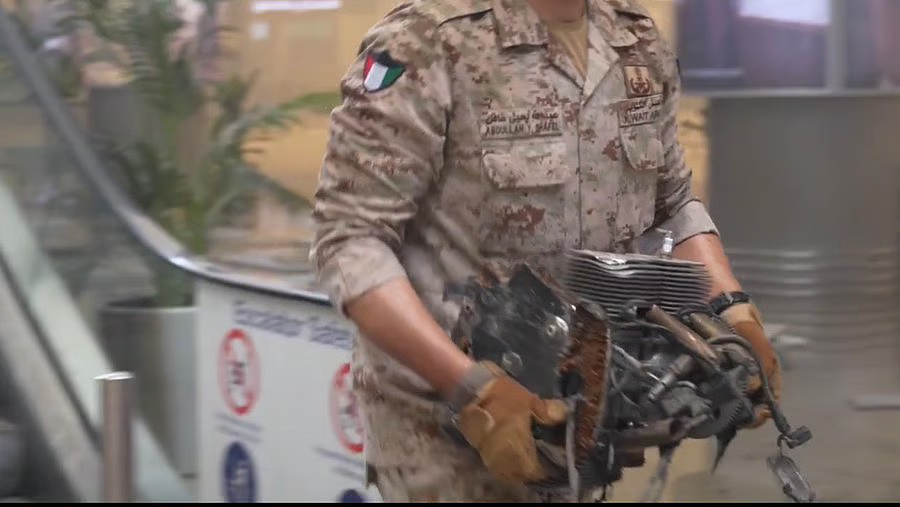
KUWAIT CITY — A major geopolitical crisis unfolded in the Gulf at dawn on Wednesday, June 3, 2026, when an Iranian Shahed-136 kamikaze drone struck Terminal 1 of Kuwait International Airport. The targeted attack killed one Indian national and left 63 others injured, severely disrupting regional aviation and triggering a swift diplomatic backlash.
Kuwaiti authorities confirmed that their air defenses intercepted 13 missiles and 17 drones during the multi-wave assault. Kuwait’s Prime Minister, Sheikh Ahmad Abdullah Al Ahmad Al Sabah, inspected the heavily damaged passenger terminal, reviewing emergency recovery operations. Following the attack, Kuwait ordered two Iranian diplomats to leave the country within 24 hours and downsized the Iranian diplomatic mission. Indian carrier IndiGo and other regional airlines suspended flights to Kuwait, though state-run Kuwait Airways has partially resumed operations.
Retaliation Claims and Defensive Denials
The Islamic Revolutionary Guard Corps (IRGC) claimed responsibility for widespread regional strikes, stating they targeted the Ali Al Salem Air Base in Kuwait and the US Fifth Fleet headquarters in Bahrain. The IRGC asserted the actions were “self-defense strikes” in retaliation for US operations against an Iranian oil tanker and island.


However, the IRGC denied intentionally striking civilian infrastructure at Kuwait International Airport. IRGC spokesperson Hossein Mohebi claimed the destruction was caused by a malfunctioning US-made Patriot air defense missile that fell onto the terminal.
US Central Command (CENTCOM) strongly rejected Iran’s narrative, labeling the claims of successful strikes on US assets as outright falsehoods.
“Iran is lying. US military assets at sea continue to fly, sail, and operate safely and unimpeded,” CENTCOM stated on X, accompanied by a “Fact Check” graphic.
CENTCOM confirmed that two Iranian missiles fired at Kuwait fell short or broke apart en route, while three missiles launched at Bahrain were intercepted. Furthermore, US forces launched self-defense counter-strikes on Iran’s Qeshm Island and disabled a Botswana-flagged oil tanker, the M/T Lexie, as it attempted to violate the US naval blockade near Kharg Island.
Global and Regional Condemnation
The attack on civilian infrastructure drew sharp condemnation from Arab states. The State of Qatar termed the strikes a grave violation of sovereignty and a blatant breach of the 1949 Geneva Conventions. Egypt and the Arab League issued separate statements reaffirming absolute solidarity with Kuwait and Bahrain, calling the escalation a direct threat to Arab national security.

In Bahrain, emergency sirens sent residents scrambling for shelter as air defenses engaged incoming targets. The Kingdom subsequently shut its airspace and grounded civilian flights. Bahraini security forces also announced the arrest of 15 individuals accused of operating as field agents for the IRGC to incite internal unrest.
Political Friction in Washington and Jerusalem
The military escalation comes amid intense diplomatic and constitutional debates in the United States. The US House of Representatives passed a war powers resolution in a 215–208 bipartisan vote, aiming to restrict President Donald Trump’s authority to conduct unauthorized military operations against Iran. Congressional watchdogs have also launched a joint review, noting that the hostilities under “Operation Epic Fury” have legally exceeded the 60-day limit set by the War Powers Act.
Despite the violence, President Trump maintained an optimistic tone during an interview on the Pod Force One podcast, claiming that backchannel negotiations involving Iran’s Supreme Leader Mojtaba Khamenei were going “very well” and could yield an interim agreement.

Concurrently, a sharp rift emerged between Trump and Israeli Prime Minister Benjamin Netanyahu. Trump confirmed using expletives during a tense phone call with Netanyahu, demanding an end to ongoing Israeli bombardment in Lebanon that threatens broader US-Iran peace talks. Netanyahu, speaking to CNBC, downplayed the friction but warned that Iran is “playing with fire.” Netanyahu emphasized that Israel remains aligned with Washington’s long-term goal to disarm Hezbollah and demilitarize Lebanon.
Economic Shockwaves
The ongoing conflict continues to strain the global economy. The OECD downgraded its 2026 global growth forecast to 2.8 percent, warning it could drop to 2.1 percent if hostilities persist into next year. In South Asia, the fallout has triggered immediate financial strain:
- India: The government approved a $1 billion support package for domestic airlines after aviation turbine fuel (ATF) prices more than doubled due to the closure of the Strait of Hormuz.
- Bangladesh: Energy shortages forced a 16 percent hike in electricity prices alongside rising fuel costs, compounding domestic inflation.